
Understand the idea.
Record the position after each instruction
For a route in space, record a new triple after each instruction. Positive adds to the first coordinate; negative subtracts from the second; movement along changes the third. Every move begins from the previous endpoint.
Distance travelled adds the positive length of every leg. Moving from to , then back to , covers units. The final position changes by only 2 units, so position change and journey length differ.
Compare locations and plan a route
To plan an axis-aligned route from to , compare their entries, then their entries, then their entries. Increase or decrease each coordinate until it matches the destination. Changing the order can give another valid route.
If each coordinate changes directly to its target without reversing, add the magnitudes of the three coordinate differences. This gives the length of that axis-aligned route. A route with detours is longer, and a straight diagonal path is a different measurement.
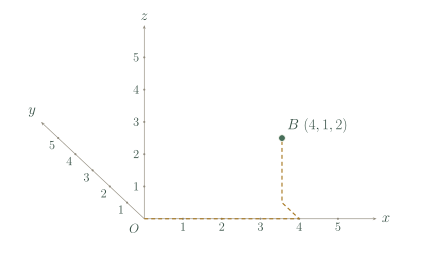
See the method in action.
Follow a route
Start at (1,2,0). Move 3 units in positive x, 2 units in positive z and 1 unit in negative y. Give the endpoint and route length.
Worked solution
- 1
Move 3 units in positive x.
An x-direction movement changes only the first coordinate.
- 2
Move 2 units in positive z.
The second move starts at the first endpoint and increases height.
- 3
Move 1 unit in negative y.
Negative y decreases the depth coordinate by 1.
- 4
Add the lengths of all three legs.
All travelled lengths contribute positively, including the negative-y leg; the endpoint is .
Endpoint (4,1,2); route length 6 units.
Plan between two points
Give an axis-aligned route from A(1,4,2) to B(3,1,5), and its length.
Worked solution
- 1
Change x from 1 to 3.
This leg moves 2 units in positive x.
- 2
Change y from 4 to 1.
This leg moves 3 units in negative y.
- 3
Change z from 2 to 5.
This leg moves 3 units in positive z and reaches B.
- 4
Calculate this route's total length.
The three axis-aligned leg lengths add; the negative direction of one leg does not subtract distance.
2 in positive x, 3 in negative y, 3 in positive z; 8 units.
Try it yourself.
Check your understanding
Start at (2,1,3) and move 4 units in negative x. What is the endpoint?
Show answer & reasoning
(−2,1,3)
Moving 4 units in negative changes only the first entry: . The endpoint is .
Keep practising
6 worksheet questions · 12 marks
Read the questions online
- Start at . Move 2 in positive , 3 in positive and 1 in positive . Give the endpoint.2 marks
- Start at . Move 2 in negative . Give the endpoint.2 marks
- Start at . Move 4 in positive then 2 in negative . Give endpoint and distance.2 marks
- Describe the change from to .2 marks
- Find the length of an axis-aligned route from to without reversing direction.2 marks
- Mia says returning to the start means the total distance is zero. She walks 3 units out and 3 back. Correct her.2 marks
Read the worked solutions
Equivalent correct methods earn the corresponding marks. Include units where asked.
- Start at . Move 2 in positive , 3 in positive and 1 in positive . Give the endpoint.2 marks
Apply each change to its matching entry.
- Start at . Move 2 in negative . Give the endpoint.2 marks
in the -entry.
- Start at . Move 4 in positive then 2 in negative . Give endpoint and distance.2 marks
Final . .
; 6 units. - Describe the change from to .2 marks
Compare corresponding entries: , , .
4 units in negative and 3 units in positive ; stays unchanged. - Find the length of an axis-aligned route from to without reversing direction.2 marks
The leg lengths are 3, 1 and 2. Add: .
6 units. - Mia says returning to the start means the total distance is zero. She walks 3 units out and 3 back. Correct her.2 marks
Both legs contribute distance: .
Her final position change is zero, but she travels 6 units.
Curriculum reference & lesson scope
Australian Curriculum v9 and SA Curriculum Mathematics
Coordinate transformations review; identifying positions using three coordinates; interpreting 3D axes; describing routes and relative positions; comparing diagrams, views and digital representations. This is spatial location, not senior vector algebra.
Official curriculum source ↗