
Understand the idea.
The two coefficients have different roles
In , the constant is the output at , so the graph meets the vertical axis at . Changing adds the same amount to every output.
The coefficient is the output change when increases by . Positive gives a rising line; negative gives a falling line. A falling line can still include positive outputs.
Compare one change at a time
Compare one coefficient at a time. The lines and share their vertical-axis crossing but rise at different rates. The lines and have equal rates and stay parallel.
Use the same axis scales to compare steepness. A larger positive coefficient does not make every output larger: for negative inputs, multiplying by a larger positive number gives a more negative product.
See the method in action.
Change the constant
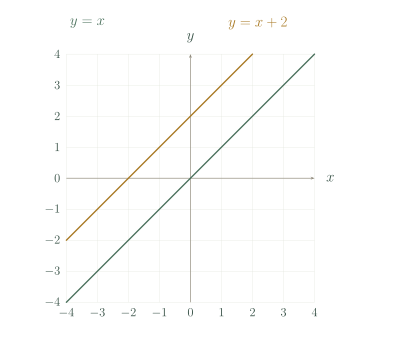
Compare and .
Worked solution
- 1
Compare outputs at the same input.
The second rule gives an output exactly greater for every , not just selected examples.
- 2
Check representative coordinates.
These rows use inputs , , in the same order and show the same vertical difference.
- 3
Describe the graph change.
The rate is unchanged, so the second line is the first line shifted up units.
The second graph shifts up 2 units.
Change direction
Compare and .
Worked solution
- 1
Find the common vertical-axis crossing.
At , both rules give the point .
- 2
Read the rates from the coefficients.
For each unit increase in input, the first output rises by two and the second falls by one.
- 3
Check one input step.
Starting from output , the outputs change by and respectively.
They share ; one rises by 2 and the other falls by 1 per input step.
Try it yourself.
Check your understanding
Describe the change from to .
Show answer & reasoning
Every output decreases by 6.
The coefficient stays , while the constant changes by . Every output decreases by , so the graph shifts down units with its rate unchanged.
Keep practising
6 worksheet questions · 14 marks
Read the questions online
- What is the output at for ?2 marks
- For , what happens to when increases by 1?2 marks
- Describe the change from to .2 marks
- Compare and at and .3 marks
- Which of and decreases as increases?2 marks
- Explain why and never meet.3 marks
Read the worked solutions
Equivalent correct methods earn the corresponding marks. Include units where asked.
- What is the output at for ?2 marks
Substitute zero.
The result is .
-3. - For , what happens to when increases by 1?2 marks
The coefficient is 5.
For example outputs 2 and 7 occur at .
It increases by 5. - Describe the change from to .2 marks
The multiplier is unchanged.
The constant increases by 4.
An upward shift of 4. - Compare and at and .3 marks
Substitute into each rule independently.
The larger coefficient does not always give a larger output.
At 2: 3 and 7. At -2: -1 and -5. - Which of and decreases as increases?2 marks
The multiplier is negative.
Each extra input unit reduces by 2.
. - Explain why and never meet.3 marks
The multipliers are equal.
Their different constants prevent equality.
Their outputs remain 3 apart for the same input.
Curriculum reference & lesson scope
Australian Curriculum v9 and SA Curriculum Mathematics (2026)
Multi-step equations; brackets and variables on both sides; equations with rational solutions; substitution checks; one-variable inequalities and number-line solutions; tables and straight-line graphs; horizontal/vertical lines; how coefficients change a graph; graphical solutions and intersection checks; real-world linear models with digital exploration.
Official curriculum source ↗