
Understand the idea.
Two different measurements
A radius joins the centre to the circle's edge. A diameter crosses the centre and contains two radii, so . First decide whether the question asks for the boundary length or the surface inside it.
Circumference is the distance once around the circle: . Area counts the square units inside: . Circumference uses length units; area uses squared units.
Keep pi until the end
Write the radius before substituting into a formula. A diameter of means . Using the diameter as the radius doubles a circumference calculation and makes an area calculation four times as large.
Leaving in an answer keeps it exact: is a complete length. If a decimal is requested, use the calculator's value and round only the final result. Use a supplied approximation when instructed.
See the method in action.
Radius supplied
A circle has radius 3 cm. Find its circumference and area exactly.
Worked solution
- 1
Identify the radius and the two formulas.
The boundary and the enclosed region require different measurements.
- 2
Calculate the circumference.
The circumference is twice the radius multiplied by pi.
- 3
Calculate the area.
Square the radius before multiplying by pi; area has square units.
Circumference cm; area cm².
Diameter supplied
A circular mat has diameter 14 m. Find its area, leaving pi in the answer.
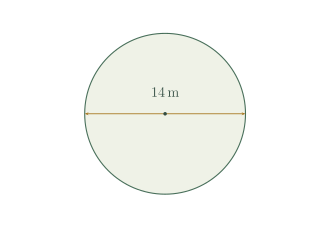
Worked solution
- 1
Convert the diameter to a radius.
A radius is half the diameter.
- 2
Substitute the radius into the area formula.
The area formula requires the radius, not the diameter.
- 3
Square the radius and retain pi.
Keeping pi gives the exact area requested.
m².
Try it yourself.
Check your understanding
A circle has radius 5 cm. What is its circumference?
Show answer & reasoning
cm.
Circumference uses . With , . The radius is not squared because this is a length.
Keep practising
6 worksheet questions · 14 marks
Read the questions online
- A circle has radius 2 cm. Find its diameter.1 mark
- Find the circumference of a circle with radius 6 cm.2 marks
- Find the area of a circle with radius 4 m.2 marks
- A circular sign has diameter 10 cm. Find its circumference and area.3 marks
- A radius doubles from 3 cm to 6 cm. By what factor does circumference change? By what factor does area change?3 marks
- A circular pond has diameter 8 m. A student writes its area as m². Explain and correct the error.3 marks
Read the worked solutions
Equivalent correct methods earn the corresponding marks. Include units where asked.
- A circle has radius 2 cm. Find its diameter.1 mark
cm.
4 cm. - Find the circumference of a circle with radius 6 cm.2 marks
cm.
cm. - Find the area of a circle with radius 4 m.2 marks
m².
m². - A circular sign has diameter 10 cm. Find its circumference and area.3 marks
The radius is cm.
cm.
cm².
cm and cm². - A radius doubles from 3 cm to 6 cm. By what factor does circumference change? By what factor does area change?3 marks
Circumference is proportional to , so its factor is 2.
Area is proportional to , so its factor is .
Circumference doubles; area is multiplied by 4. - A circular pond has diameter 8 m. A student writes its area as m². Explain and correct the error.3 marks
The radius is 4 m.
m².
They squared the diameter. Correct area: m².
Curriculum reference & lesson scope
Australian Curriculum v9 / SA Curriculum
Circumference and area of circles; perimeter/area of composite shapes; choosing and converting area units; cross-sections of prisms; prism volume and capacity; mixed measurement applications.
Official curriculum source ↗