
Understand the idea.
Degree, sign and multiplicity
The leading term determines a polynomial’s end behaviour. A positive cubic falls to the left and rises to the right; a positive quartic rises at both ends. Negative leading coefficients reverse those directions, while lower-degree terms determine the middle of the graph.
At a root of odd multiplicity the sign changes, so the curve crosses the horizontal axis. At a root of even multiplicity it touches without crossing. Combine roots, multiplicities, the vertical-axis intercept and end behaviour before refining the sketch.
Use structure and context
An equation containing only even powers can sometimes be reduced by . Solve the resulting equation in , keeping for real x. Each positive gives two real x-values, zero gives one, and negative gives none.
A physical polynomial model may use only a small part of its full graph. For a box formed by cutting a sheet, positive cut sizes and remaining side lengths determine the feasible interval. Establish that domain before interpreting roots, negative outputs or turning points.
See the method in action.
A repeated cubic root
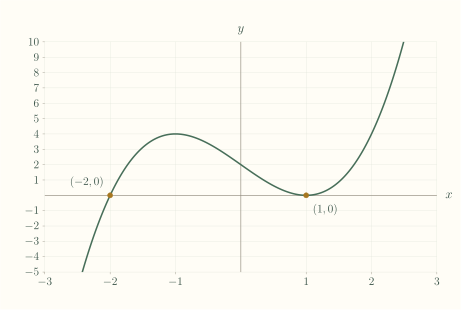
Describe .
Worked solution
- 1
Find the roots and their multiplicities.
The factor x plus two occurs once, while x minus one occurs twice.
- 2
Describe the behaviour at the intercepts.
Odd multiplicity changes the sign across a root; even multiplicity keeps the same sign on both sides.
- 3
Calculate the vertical-axis intercept.
The curve therefore passes through the point with coordinates zero and two.
- 4
Determine the direction of both ends.
The positive cubic leading term makes the left end fall and the right end rise; these directions supplement the intercept information.
Crosses (-2,0), touches (1,0), passes (0,2).
Quadratic in x squared
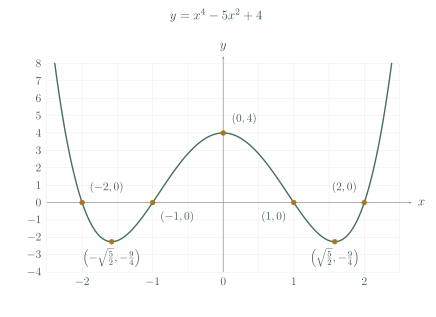
Solve .
Worked solution
- 1
Reduce the equation using a non-negative substitution.
The fourth power is the square of the second power, so the new equation is quadratic.
- 2
Factor and solve for the new variable.
The constants negative one and negative four have sum negative five and product four.
- 3
Return to x using both square-root branches.
Both u-values are positive, so each supplies a positive and a negative real root.
- 4
Confirm all roots in a real factorisation.
These four factors give exactly the four roots negative two, negative one, one and two.
Try it yourself.
Check your understanding
Does cross at x=3?
Show answer & reasoning
No; it touches.
The factor has even multiplicity, and the other factor is nonzero at . The sign does not change there, so the curve touches the horizontal axis rather than crossing it.
Keep practising
6 worksheet questions · 15 marks
Read the questions online
- Describe crossing/touching roots of .2 marks
- State end behaviour of .2 marks
- Solve .3 marks
- Solve for real .3 marks
- Cut squares of side cm from the corners of a 12 cm by 8 cm sheet and fold a box. Give volume and domain.3 marks
- A box has volume cubic centimetres. Find its volume when and when .2 marks
Read the worked solutions
Equivalent correct methods earn the corresponding marks. Include units where asked.
- Describe crossing/touching roots of .2 marks
Use multiplicities one and two.
Crosses at -1; touches at 2. - State end behaviour of .2 marks
The leading degree is even and coefficient negative.
Both ends fall. - Solve .3 marks
Let : .
Use both roots of each positive .
- Solve for real .3 marks
The u-equation is .
Reject for real .
- Cut squares of side cm from the corners of a 12 cm by 8 cm sheet and fold a box. Give volume and domain.3 marks
The three dimensions must be positive.
Multiply height, length and width.
cubic centimetres; . - A box has volume cubic centimetres. Find its volume when and when .2 marks
At 1: .
At 2: .
60 cubic centimetres and 64 cubic centimetres.
Curriculum reference & lesson scope
SACE Board of South Australia
Stage 1 Mathematics topics 2.1–2.2: quadratic relationships, cubic and quartic polynomials. Original Ascent teaching sequence.
Official curriculum source ↗