
Understand the idea.
Stationary versus turning
A stationary point is a point on the curve with zero derivative. Solve for its input, then substitute into for its height. Writing only the derivative root does not give the point’s full coordinates.
Classify the point by following the graph from left to right. A positive-to-negative derivative change gives a local maximum; a negative-to-positive change gives a local minimum. With no sign change, a horizontal tangent is not a turning point.
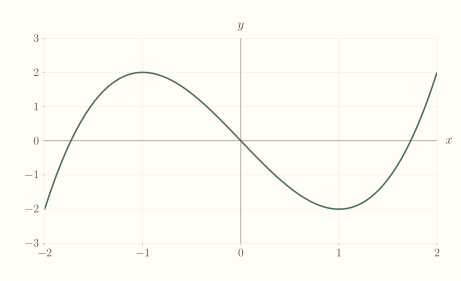
Support the classification
Use the factored derivative to justify signs on both sides of each stationary input. For polynomial functions, its roots divide the real line into intervals of fixed derivative sign. This supports classification across whole intervals rather than relying only on the sketch.
Local extrema compare nearby values. They need not be greatest or least across the whole domain. On a restricted interval, an endpoint may beat every stationary value. Also remember that has a stationary point at zero without either a maximum or a minimum.
See the method in action.
Worked example 1
Classify the stationary point of .
Worked solution
- 1
Find the stationary input.
Stationary points have zero tangent gradient.
- 2
Calculate the corresponding height.
The original function supplies the vertical coordinate, giving .
- 3
Check the derivative on both sides.
The graph falls towards and rises away from it, so the point is a minimum.
Minimum (2,1).
Worked example 2
Classify stationary points of .
Worked solution
- 1
Differentiate and factor.
Factoring identifies all roots of the quadratic derivative.
- 2
Find the stationary inputs.
A product is zero when at least one factor is zero.
- 3
Calculate both stationary heights.
Substituting into the original cubic gives the points and .
- 4
Use derivative signs to classify the points.
The factors give a positive-to-negative change at 1 and a negative-to-positive change at 3: local maximum and local minimum .
Local maximum (1,5); local minimum (3,1).
Try it yourself.
Check your understanding
A derivative changes from negative to positive at x=4. What type of stationary point is there?
Show answer & reasoning
Local minimum.
The derivative is negative before and positive after it. The graph therefore falls towards the stationary point and rises away, which identifies a local minimum.
Keep practising
6 worksheet questions · 21 marks
Read the questions online
- Find and classify the stationary point of .3 marks
- Classify the stationary point of .3 marks
- Describe the stationary point of .3 marks
- Classify all stationary points of .4 marks
- Classify all stationary points of .5 marks
- Explain why has a stationary minimum at 0.3 marks
Read the worked solutions
Equivalent correct methods earn the corresponding marks. Include units where asked.
- Find and classify the stationary point of .3 marks
at .
; signs change − to +.
Minimum - Classify the stationary point of .3 marks
at 3.
; signs change + to −.
Maximum - Describe the stationary point of .3 marks
is zero at 0.
The derivative is positive on both sides, so there is no turn.
, neither maximum nor minimum. - Classify all stationary points of .4 marks
.
Signs +, −, + give the types; evaluate at and 2.
Maximum ; minimum . - Classify all stationary points of .5 marks
.
Signs across , 0 and 2 are −, +, −, +.
Maximum ; minima and . - Explain why has a stationary minimum at 0.3 marks
is negative before 0 and positive after 0.
The point is ; the derivative changes − to +.
Curriculum reference & lesson scope
SACE Board of South Australia
Stage 1 Mathematics topic 6: rates of change, derivatives and applications. Introductory polynomial calculus with explicit modelling and interpretation.
Official curriculum source ↗