
Understand the idea.
A circle is a fixed-distance relation
A circle consists of points a fixed positive distance from a centre . Applying the distance formula gives . Read each bracket as a coordinate difference, rather than copying its written sign.
The extreme coordinates are and horizontally, and and vertically. These bounds guide a sketch. Interior inputs generally have two outputs, so the full circle is a relation rather than a function of x.
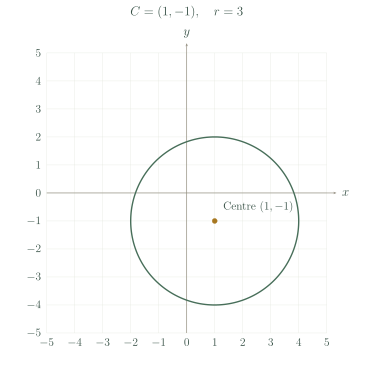
Select a branch and check other relations
Isolating the squared vertical difference gives . The plus sign selects the upper semicircle and the minus sign the lower. Each branch is a function on .
An expanded equation may need completing the square before its centre and radius become visible. The next chapter develops that technique. Squared terms alone do not identify a circle: their equal coefficients, signs and resulting radius must also be checked.
See the method in action.
Read a circle
State the centre and radius of .
Worked solution
- 1
Match the equation to circle form.
Standard form uses differences from the centre and the square of the radius.
- 2
Read the centre coordinates.
The brackets vanish at the centre’s coordinates; the plus two corresponds to horizontal coordinate negative two.
- 3
Take the positive radius.
A radius is a positive length, so sixteen is its square rather than its value.
Centre (-2,1), radius 4.
Write a restricted branch
Write the upper semicircle of a circle centred at (1,-2) with radius 3, including its domain.
Worked solution
- 1
Write the full circle from its centre and radius.
The centre is one horizontally and negative two vertically, with radius three.
- 2
Isolate the upper branch.
The upper semicircle has y at least negative two, so the positive square-root branch is required.
- 3
Require a real square root.
The radicand is non-negative precisely between the circle’s leftmost and rightmost points, including both endpoints.
, .
Try it yourself.
Check your understanding
What are the centre and radius of ?
Show answer & reasoning
Centre (0,-3), radius 5.
Write the equation as . Its centre is and its radius is .
Keep practising
6 worksheet questions · 12 marks
Read the questions online
- State the centre and radius of .2 marks
- Write the equation of a circle centred at with radius 5.2 marks
- Does lie on ? Explain.2 marks
- Find the x-intercepts of .2 marks
- Write the lower semicircle of , including domain and range.2 marks
- A circular sprinkler reaches 6 m from a nozzle at on a metre grid. Give its boundary equation and decide whether lies inside.2 marks
Read the worked solutions
Equivalent correct methods earn the corresponding marks. Include units where asked.
- State the centre and radius of .2 marks
Read the bracket signs and take the positive square root of 9.
Centre , radius 3. - Write the equation of a circle centred at with radius 5.2 marks
Insert , and .
. - Does lie on ? Explain.2 marks
.
Yes. - Find the x-intercepts of .2 marks
Set : , so .
and . - Write the lower semicircle of , including domain and range.2 marks
Select the negative square-root branch.
Its x-values run across the diameter, while its outputs run from -4 to 0.
; domain , range . - A circular sprinkler reaches 6 m from a nozzle at on a metre grid. Give its boundary equation and decide whether lies inside.2 marks
Its squared distance from the nozzle is .
Thus its distance is less than 6 m.
Boundary ; is inside.
Curriculum reference & lesson scope
SACE Board of South Australia
Stage 1 Mathematics, Topic 1: Functions and graphs. Prerequisite algebra and coordinate geometry are embedded as supporting lessons.
Official curriculum source ↗