
Understand the idea.
Change divided by interval
An average rate answers: what constant rate would produce the same overall change over this interval? Calculate the two endpoint outputs, subtract them in matching order, then divide by the elapsed input. The endpoints must be distinct.
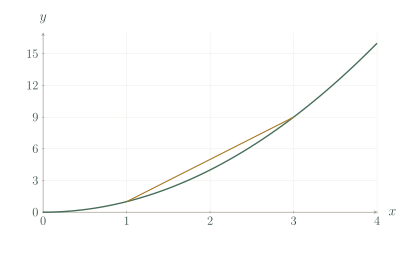
On a graph this calculation is the gradient of the secant joining and . It summarises the whole interval; it does not require the curve to have that gradient at either endpoint.
Interpret the result
Attach output units divided by input units. A tank losing in has average rate . The negative sign records falling volume; the size tells how fast it falls on average.
Equal endpoint heights give zero average rate, even if the graph moves between them. A journey returning to its starting position can have zero average velocity while the traveller has still covered distance. Check what quantity the vertical axis measures.
See the method in action.
Worked example 1
Find the average rate of from to .
Worked solution
- 1
Evaluate the function at both endpoints.
A secant uses the heights of two points on the original curve.
- 2
Calculate the changes in matching order.
Both differences describe the move from input 1 to input 3.
- 3
Divide output change by input change.
The output rises by 4 units per input unit on average over this interval.
4 output units per input unit.
Worked example 2
A tank has litres after minutes. Find its average rate from 2 to 7 minutes.
Worked solution
- 1
Find the volumes at the stated times.
Substituting the endpoint times gives the initial and final volumes for this interval.
- 2
Find the volume change and elapsed time.
The final volume is smaller, so its signed change is negative.
- 3
Calculate and interpret the average rate.
The tank loses 6 litres per minute on average; this linear model also has that rate throughout.
−6 L/min: the volume falls by 6 litres per minute.
Try it yourself.
Check your understanding
What is the average rate of from 0 to 4?
Show answer & reasoning
3
and , so . The line rises by 3 output units for each input unit, making every secant gradient 3.
Keep practising
6 worksheet questions · 18 marks
Read the questions online
- Find the average rate of from 0 to 4.3 marks
- Find the secant gradient of between 1 and 3.3 marks
- A population rises from 320 to 395 over 5 years. Find its average yearly increase.3 marks
- . Find its average rate from 2 to 7.3 marks
- A secant passes through and . Find its gradient.3 marks
- on . Its average rate is 0. Must its instantaneous rate always be 0? Explain.3 marks
Read the worked solutions
Equivalent correct methods earn the corresponding marks. Include units where asked.
- Find the average rate of from 0 to 4.3 marks
.
.
4 - Find the secant gradient of between 1 and 3.3 marks
.
.
13 - A population rises from 320 to 395 over 5 years. Find its average yearly increase.3 marks
The change is people.
Divide by 5 years: .
15 people per year - . Find its average rate from 2 to 7.3 marks
.
.
units per time unit - A secant passes through and . Find its gradient.3 marks
.
.
4 - on . Its average rate is 0. Must its instantaneous rate always be 0? Explain.3 marks
, but .
Equal endpoints do not imply a constant graph.
No. It falls and rises back to the starting value.
Curriculum reference & lesson scope
SACE Board of South Australia
Stage 1 Mathematics topic 6: rates of change, derivatives and applications. Introductory polynomial calculus with explicit modelling and interpretation.
Official curriculum source ↗