
Understand the idea.
Constant factor, not constant difference
Exponential change multiplies the current amount by a fixed factor over each equal time interval. In , the initial value is because . Equal time steps have equal ratios, rather than equal differences.
For a positive initial amount, describes growth and describes decay. Convert a percentage to a decimal rate first: a rise uses , while a fall uses .
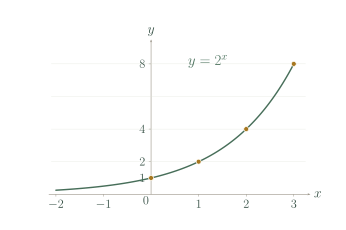
Check the unit and the claim
The exponent counts how many multiplier-periods have passed. An hourly multiplier requires time in hours, while an annual multiplier requires years. Applying the percentage again means multiplying the new amount, not repeatedly changing the original amount.
Treat the rule as a model over an appropriate interval. Resources or changing conditions may prevent indefinite growth. With a positive decay factor, every finite-time output stays positive even though the long-term limit may be zero.
See the method in action.
Build a growth rule
A culture starts with 400 cells and grows by 15% each hour. Model its size and predict 3 hours ahead.
Worked solution
- 1
Convert the growth rate into a multiplier.
The culture keeps its original amount and gains a further 15 percent each hour.
- 2
Write the model with its time unit.
The time-zero count is 400, and each one-hour interval contributes one factor of 1.15.
- 3
Predict and round the count.
The model output is rounded to a whole cell for an interpreted count.
; about 608 cells.
Read a decay factor
For in dollars and years, find the annual loss and value after 2 years.
Worked solution
- 1
Interpret the remaining-value factor.
Keeping 82 percent of the previous value means losing 18 percent of that value.
- 2
Count two annual multiplications.
Time is measured in years, so two years gives exponent 2.
- 3
Evaluate to currency precision.
The second percentage loss acts on the reduced first-year value.
18% annual loss; 12,103.20 dollars.
Try it yourself.
Check your understanding
What decrease is represented by ?
Show answer & reasoning
6% per time unit.
The factor keeps 94 percent of the quantity each time unit. The decrease is , or 6 percent per time unit.
Keep practising
6 worksheet questions · 14 marks
Read the questions online
- A quantity is multiplied by 1.07 monthly. State its percentage change.2 marks
- Model 250 grams decreasing by 12% each day.2 marks
- For , find .2 marks
- The equally spaced values are 5, 15, 45, 135. Does an exponential model fit?2 marks
- Compare and .3 marks
- Will equal zero at any finite real ? Explain.3 marks
Read the worked solutions
Equivalent correct methods earn the corresponding marks. Include units where asked.
- A quantity is multiplied by 1.07 monthly. State its percentage change.2 marks
1.07 is the original 1 plus 0.07.
7% monthly increase. - Model 250 grams decreasing by 12% each day.2 marks
The retained factor is .
, in days. - For , find .2 marks
.
432 - The equally spaced values are 5, 15, 45, 135. Does an exponential model fit?2 marks
Each next value divided by the previous one gives 3.
Yes: common multiplier 3. - Compare and .3 marks
; .
adds 5 per period; adds 25% of its current value. - Will equal zero at any finite real ? Explain.3 marks
for every finite real , so the product is positive.
No.
Curriculum reference & lesson scope
SACE Board of South Australia
Stage 1 Mathematics: exponential and logarithmic functions, growth models and numerical/algebraic prerequisites.
Official curriculum source ↗