
Understand the idea.
A cycle of sine and cosine
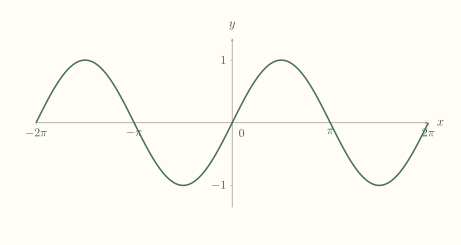
A sine or cosine graph records one unit-circle coordinate as the angle changes. Mark quarter-turn inputs to capture zeros and turning points, then join smoothly. Both functions repeat after , with outputs between and .
Tangent has asymptotes
Tangent repeats after because the coordinate quotient is unchanged by a half-turn. It is zero at and undefined at , where cosine vanishes and is an integer.
Each tangent branch covers every real output and grows without bound near its vertical asymptotes. Draw the branches separately. Since there is no finite maximum or minimum, tangent has no amplitude.
See the method in action.
Worked example 1
List five key points of on .
Worked solution
- 1
Choose the quarter-cycle inputs.
A full cosine cycle is divided into four equal angle intervals.
- 2
Read the horizontal circle coordinates.
Cosine records horizontal position on the unit circle.
- 3
Pair each input with its output.
The last point returns to the starting height after one complete cycle.
Worked example 2
For on , state its zero, range and asymptotes.
Worked solution
- 1
Find the zero of the branch.
Within this interval, sine is zero only at zero and cosine there is nonzero.
- 2
Identify the excluded boundary lines.
Cosine is zero at each boundary, so tangent is undefined and has vertical asymptotes.
- 3
State the output range.
The continuous increasing branch runs from arbitrarily negative to arbitrarily positive values.
Zero 0; range ; asymptotes .
Try it yourself.
Check your understanding
What is the period of cosx?
Show answer & reasoning
The period is : after one full turn, every unit-circle coordinate repeats, so for every real .
Keep practising
6 worksheet questions · 18 marks
Read the questions online
- List zeros of on .3 marks
- Where does attain on ?3 marks
- State the range and period of .3 marks
- Give tangent asymptotes between and .3 marks
- Find all with on .3 marks
- Compare with , and with .3 marks
Read the worked solutions
Equivalent correct methods earn the corresponding marks. Include units where asked.
- List zeros of on .3 marks
Sine is zero at points on the horizontal axis.
- Where does attain on ?3 marks
The leftmost unit-circle point has horizontal coordinate .
- State the range and period of .3 marks
Use the vertical extremes and the repeating cycle.
Range ; period . - Give tangent asymptotes between and .3 marks
These are the odd half-pi values in the interval.
- Find all with on .3 marks
Cosine vanishes at the vertical-axis points.
- Compare with , and with .3 marks
The added angles are whole periods of the corresponding functions.
They are equal respectively.
Curriculum reference & lesson scope
SACE Board of South Australia
Stage 1 Mathematics: triangle rules, circular measure and trigonometric functions; school sequencing may vary.
Official curriculum source ↗