
Understand the idea.
Shortening an interval
To investigate the rate at one instant, keep one point fixed and bring a second point towards it. Each pair gives a secant gradient. If these gradients approach the same finite number from both sides, that number is the tangent gradient.
One short interval gives an estimate, not an exact derivative. Compare progressively shorter intervals and distinguish their calculated slopes from the limiting value. At a corner, approaching from the left and right may give different slopes, so a derivative need not exist.
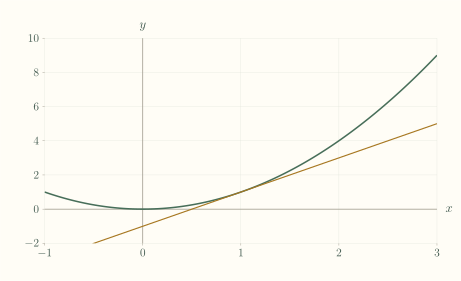
Difference quotient and limit
The difference quotient compares the inputs and , where . Substitute the entire expression into the function, expand carefully and simplify the numerator before dividing by . This keeps the second point distinct from the first.
After cancellation valid for , take the limit as . The limit concerns nearby nonzero increments, so it can exist even though the original quotient is undefined at zero. Directly substituting into the original quotient produces , which has no numerical value.
See the method in action.
Worked example 1
Find the instantaneous gradient of at 3 from a difference quotient.
Worked solution
- 1
Form the secant quotient at input 3.
The second input is 3 plus a nonzero increment.
- 2
Expand and collect the numerator.
Expanding the square exposes a factor of the increment in every remaining term.
- 3
Cancel the nonzero increment.
Cancellation is valid before the limiting step because the secant still has distinct inputs.
- 4
Take the limit from either side.
The remaining increment tends to zero for positive and negative approaches.
6
Worked example 2
For , estimate the rate at 1 using , then find its limit.
Worked solution
- 1
Set up the quotient at time 1.
The quotient measures average change over the time increment.
- 2
Expand and simplify for nonzero increments.
The constant terms cancel, leaving a common factor of the increment.
- 3
Calculate the two requested estimates.
These are finite secant gradients, each still different from the exact instantaneous rate.
- 4
Find the exact limiting rate.
Both variable terms tend to zero from either side, giving 3 output units per time unit.
Instantaneous rate 3 output units per time unit.
Try it yourself.
Check your understanding
A simplified difference quotient is . What is its limit as h tends to 0?
Show answer & reasoning
8
As , the term tends to zero while the constant 8 stays fixed. Therefore .
Keep practising
6 worksheet questions · 18 marks
Read the questions online
- Use a difference quotient for at 1.3 marks
- Use a difference quotient for at 2.3 marks
- Find the gradient of at 1 using its difference quotient.3 marks
- For at 2, calculate secant gradients for and state the limiting value.3 marks
- For at 0, compare the left and right difference quotients. Does one derivative exist?3 marks
- metres. Use a limiting quotient to find velocity at 3 seconds.3 marks
Read the worked solutions
Equivalent correct methods earn the corresponding marks. Include units where asked.
- Use a difference quotient for at 1.3 marks
for .
The limit is 2.
2 - Use a difference quotient for at 2.3 marks
.
Its limit is 12.
12 - Find the gradient of at 1 using its difference quotient.3 marks
.
The limit is 3.
3 - For at 2, calculate secant gradients for and state the limiting value.3 marks
The quotient is .
Substitute the three -values and then let approach 0.
5, 4.1, 4.01; limit 4 - For at 0, compare the left and right difference quotients. Does one derivative exist?3 marks
equals 1 for positive and for negative .
The two limiting slopes disagree.
Left slope , right slope 1; no derivative. - metres. Use a limiting quotient to find velocity at 3 seconds.3 marks
.
The limit is 30 metres per second.
30 m/s
Curriculum reference & lesson scope
SACE Board of South Australia
Stage 1 Mathematics topic 6: rates of change, derivatives and applications. Introductory polynomial calculus with explicit modelling and interpretation.
Official curriculum source ↗