
Understand the idea.
Satisfy both conditions
A simultaneous solution satisfies both equations at once. For two lines, it is their intersection. Use substitution when one variable is already isolated; use elimination when multiplying and combining equations can remove one variable.
Apply each algebraic operation to every term on both sides. After finding one variable, substitute into an original equation for the other. Checking the pair in both original equations tests the shared condition, rather than just one line.
Interpret the number of solutions
Distinct parallel lines have no solution; equations describing the same line have infinitely many. A contradiction such as signals no common point. An identity such as leaves a whole line of possibilities rather than fixing the origin.
A contextual solution must also satisfy the quantities’ restrictions. Ticket counts must be non-negative integers, for example. Define the variables, set up both constraints, and report the answer with its meaning and units.
See the method in action.
Substitution
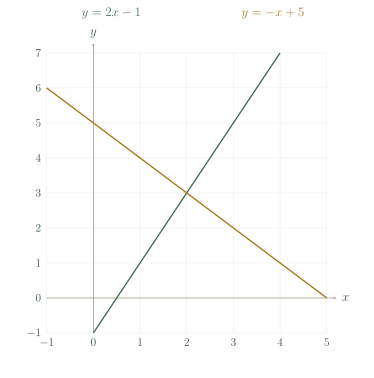
Solve and .
Worked solution
- 1
Equate the two expressions for the same output.
At an intersection, both rules must give the same y-value.
- 2
Solve for the input.
Adding x, then one, and dividing by three preserves equality.
- 3
Find and check the shared output.
Both original rules give three at input two, so the intersection is the point with coordinates two and three.
A ticket model
Adult tickets cost 14 dollars and student tickets cost 9 dollars. Ten tickets bring in 115 dollars. How many of each were sold?
Worked solution
- 1
Translate the count and revenue constraints.
Let a count adult tickets and s count student tickets; revenue is price multiplied by count.
- 2
Eliminate the student count by substitution.
The total-ticket equation expresses the student count in terms of the adult count.
- 3
Solve for both counts.
Solving the reduced equation and substituting back gives whole, non-negative counts.
- 4
Verify both constraints.
Five tickets of each type match both the total number and the total revenue.
5 adult tickets and 5 student tickets.
Try it yourself.
Check your understanding
Solve and .
Show answer & reasoning
, .
Adding the equations gives , hence . Then ; the check confirms the second equation as well.
Keep practising
6 worksheet questions · 12 marks
Read the questions online
- Solve and .2 marks
- Solve and .2 marks
- Solve and .2 marks
- Classify and by their number of simultaneous solutions.2 marks
- Classify and .2 marks
- Plan A costs 18 dollars plus 4 dollars per visit; Plan B costs 6 dollars plus 7 dollars per visit. At what number of visits are their costs equal?2 marks
Read the worked solutions
Equivalent correct methods earn the corresponding marks. Include units where asked.
- Solve and .2 marks
Set to obtain , then .
- Solve and .2 marks
Add equations: , then .
- Solve and .2 marks
Use : , so and .
- Classify and by their number of simultaneous solutions.2 marks
The second is : distinct parallel lines.
No solutions. - Classify and .2 marks
The second is three times the first; both describe one line.
Infinitely many solutions. - Plan A costs 18 dollars plus 4 dollars per visit; Plan B costs 6 dollars plus 7 dollars per visit. At what number of visits are their costs equal?2 marks
Solve to obtain .
Check both original costs.
4 visits; both cost 34 dollars.
Curriculum reference & lesson scope
SACE Board of South Australia
Stage 1 Mathematics, Topic 1: Functions and graphs. Prerequisite algebra and coordinate geometry are embedded as supporting lessons.
Official curriculum source ↗