
Understand the idea.
A relation need not be a function
A relation is a set of ordered pairs. It is a function of when every permitted input is assigned exactly one output . Several different inputs may share an output; the restriction concerns conflicting outputs for the same input.
For a finite relation, group pairs by their first coordinate. Repeated identical pairs add no conflict, but and do. Always identify the input variable: reversing the roles of the coordinates can change whether a relation is a function.
A graphical test
A vertical line fixes one input . Two intersection points mean that input has two outputs, so the graph fails the vertical-line test. Horizontal lines instead check repeated outputs and are relevant to whether a function is one-to-one.
An entire circle fails because an interior input can have an upper and a lower output. Selecting its upper semicircle removes that ambiguity. A finite sample of a curve cannot prove the test holds at all other inputs; use the rule or full graph.
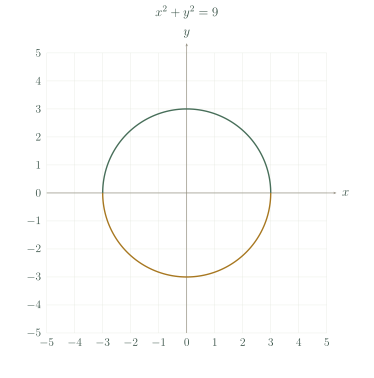
See the method in action.
Repeated outputs are allowed
Does define a function of x?
Worked solution
- 1
List each distinct input and its assigned output.
These are all pairs in the supplied finite relation.
- 2
Check for conflicting outputs.
Each input appears with exactly one output, so the relation is a function of its first coordinate.
- 3
Interpret the repeated output.
Two different inputs sharing four is allowed; it only shows this function is not one-to-one.
Yes.
A circle and a semicircle
Compare with .
Worked solution
- 1
Test the full circle at a single input.
The input zero has two outputs, which is enough to show the full circle is not a function of x.
- 2
Find the square-root rule’s permitted inputs.
The radicand must be non-negative for the output to be real.
- 3
Identify the selected branch.
The principal square root gives exactly one non-negative output at every permitted input, so the upper semicircle is a function.
The full circle is not a function of x; the upper semicircle is, on .
Try it yourself.
Check your understanding
Is a function of its first coordinate?
Show answer & reasoning
No.
The pairs and assign different outputs to the same first coordinate . Therefore the given relation is not a function of its first coordinate.
Keep practising
6 worksheet questions · 12 marks
Read the questions online
- Decide whether is a function of .2 marks
- Decide whether is a function of .2 marks
- Is the relation a function of ? Explain.2 marks
- Is a function of , and is each output produced by only one input?2 marks
- Restrict to give a function with non-positive outputs.2 marks
- A table lists , and . Does it prove for every real ?2 marks
Read the worked solutions
Equivalent correct methods earn the corresponding marks. Include units where asked.
- Decide whether is a function of .2 marks
Every input has exactly one output, although all outputs coincide.
Yes. - Decide whether is a function of .2 marks
Input -2 has two different outputs.
No. - Is the relation a function of ? Explain.2 marks
The same x-value 3 permits every real y-value, so a vertical line overlaps it at many points.
No. - Is a function of , and is each output produced by only one input?2 marks
Every has one square.
For example, inputs 2 and -2 both produce 4.
It is a function of , but it is not one-to-one on all real inputs. - Restrict to give a function with non-positive outputs.2 marks
Select the lower semicircle, which assigns one non-positive y-value to each allowed .
, . - A table lists , and . Does it prove for every real ?2 marks
It agrees with that rule at the listed inputs, but many other rules have those same three values.
No.
Curriculum reference & lesson scope
SACE Board of South Australia
Stage 1 Mathematics, Topic 1: Functions and graphs. Prerequisite algebra and coordinate geometry are embedded as supporting lessons.
Official curriculum source ↗