
Understand the idea.
Move the graph while tracking its features
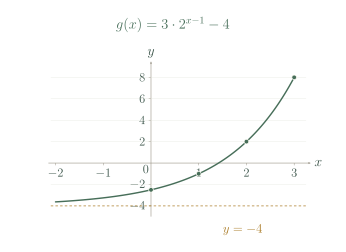
In , use , and . The exponential factor is always positive. Multiplying by scales it vertically and reflects it when ; adding moves the horizontal asymptote to .
The inside expression shifts the parent graph right by . It does not directly give the vertical intercept. To find that intercept, set in the complete transformed rule.
Explain domain and range from positivity
The domain is all real inputs for a valid positive exponential base. Positivity determines the range: puts the graph above , while puts it below . The asymptote itself is excluded because the exponential contribution never vanishes.
Use the asymptote, monotonic direction and a few exact points to sketch the curve. A graphing window only displays part of it; the edges of the screen do not create endpoints in its domain or range.
See the method in action.
Shift and stretch
Describe and find its y-intercept.
Worked solution
- 1
Read the transformations from the parent function.
Shift right 1, stretch vertically by factor 3, then move down 4.
- 2
Find the vertical intercept by substitution.
The input is zero at every point on the vertical axis.
- 3
Use positivity to identify the features.
The term three times the exponential is always positive and can approach zero.
- 4
State the intercept and range.
The asymptote is a strict lower bound and is never reached.
Intercept (0,-2.5); asymptote y=-4; range above -4.
Reflect an exponential
Find the range and x-intercept of .
Worked solution
- 1
Find the range from the positive exponential.
Subtracting a strictly positive term keeps the output strictly below 5.
- 2
Set the output to zero.
An x-intercept has zero vertical coordinate.
- 3
Solve for the exponent.
Common logarithms and the power law isolate the exponent.
- 4
State the graph features.
The exponential can become arbitrarily large or approach zero, but cannot equal zero.
Range ; x-intercept approximately (2.322,0).
Try it yourself.
Check your understanding
What is the asymptote of ?
Show answer & reasoning
The exponential contribution approaches zero as grows. Adding 7 makes the horizontal asymptote .
Keep practising
6 worksheet questions · 13 marks
Read the questions online
- Find the domain and range of .2 marks
- Find the -intercept of .2 marks
- Describe the transformations from to .2 marks
- Find the asymptote and range of .2 marks
- Find the -intercept of .2 marks
- Explain why is not the same graph as .3 marks
Read the worked solutions
Equivalent correct methods earn the corresponding marks. Include units where asked.
- Find the domain and range of .2 marks
is defined and positive for all real .
Domain ; range . - Find the -intercept of .2 marks
At , .
- Describe the transformations from to .2 marks
The inner shifts left; the outer -2 stretches and reflects.
Left 1; vertical stretch factor 2; reflection in the -axis; up 4. - Find the asymptote and range of .2 marks
Four times the exponential is positive, so subtracting it stays below 6.
Asymptote ; range . - Find the -intercept of .2 marks
, so and .
- Explain why is not the same graph as .3 marks
The first adds 1 to every output; the second multiplies by 2.
They also have different values at : 3 and 4.
The first has asymptote ; the second has asymptote .
Curriculum reference & lesson scope
SACE Board of South Australia
Stage 1 Mathematics: exponential and logarithmic functions, growth models and numerical/algebraic prerequisites.
Official curriculum source ↗