
Understand the idea.
Allowed inputs come first
The domain is the set of permitted inputs. For a real-valued rule, exclude values that make a denominator zero and require the expression inside an even square root to be non-negative. Context may impose further restrictions, such as positive lengths.
Record restrictions before simplifying. Although when , the original rule is undefined at . Cancelling a factor preserves values on the original domain; it does not restore an excluded input.
Find what the outputs can do
The range is the set of outputs actually attained by inputs in the domain. First find possible turning points and endpoint outputs. A vertex supplies a boundary only if its input is permitted; restricting the domain can change both smallest and largest outputs.
Included endpoints use closed brackets or ; excluded boundaries use open brackets or strict inequalities. For continuous curves, account for all intervening outputs, rather than treating a few calculated values as the complete range.
See the method in action.
A denominator restriction
State the domain and range of .
Worked solution
- 1
Exclude a zero denominator.
Division is defined for every real input other than two.
- 2
Show that zero cannot be an output.
A fraction with nonzero numerator and a finite nonzero denominator cannot equal zero.
- 3
Check that every other output is achievable.
Each nonzero real output gives a real input different from two; hence the domain excludes two and the range excludes zero.
Domain: all real x except 2. Range: all real outputs except 0.
A restricted quadratic
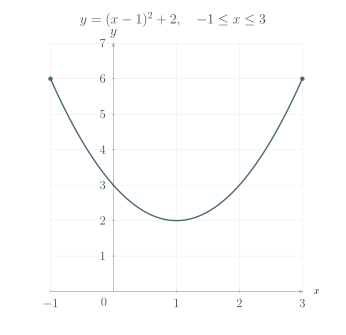
Find the domain and range of for .
Worked solution
- 1
Keep the stated input restriction.
Both endpoints are included in the question.
- 2
Find the minimum within that domain.
The square vanishes at the permitted input one, so two is an attained minimum.
- 3
Find the largest distance from the vertex.
On this interval neither endpoint is more than two units from the vertex.
- 4
Confirm the upper boundary and intervening values.
The quadratic is continuous and reaches both its minimum and maximum, so every value between them occurs.
Domain ; range .
Try it yourself.
Check your understanding
Find the real domain of .
Show answer & reasoning
.
A real square root requires . Subtracting four gives the complete domain , including the input that produces zero.
Keep practising
6 worksheet questions · 12 marks
Read the questions online
- State the real domain of .2 marks
- State the real domain of .2 marks
- Find the range of for all real .2 marks
- Find the range of on .2 marks
- Simplify and retain its original domain restriction.2 marks
- A square has perimeter . State a sensible domain and range when side length s is measured in centimetres.2 marks
Read the worked solutions
Equivalent correct methods earn the corresponding marks. Include units where asked.
- State the real domain of .2 marks
Exclude the input that makes zero.
, . - State the real domain of .2 marks
Require , then solve the inequality.
. - Find the range of for all real .2 marks
A square is non-negative; its negative is non-positive. Equality occurs at .
. - Find the range of on .2 marks
The function increases; and .
. - Simplify and retain its original domain restriction.2 marks
Factor the numerator as .
Cancellation is valid only when is non-zero.
, with . - A square has perimeter . State a sensible domain and range when side length s is measured in centimetres.2 marks
A non-degenerate square has positive side length, and multiplying by 4 preserves positivity.
and .
Curriculum reference & lesson scope
SACE Board of South Australia
Stage 1 Mathematics, Topic 1: Functions and graphs. Prerequisite algebra and coordinate geometry are embedded as supporting lessons.
Official curriculum source ↗