
Understand the idea.
Find both point and gradient
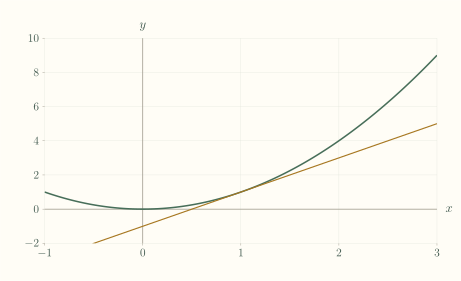
A line needs a point and a gradient. At input , calculate the point from the original function and the tangent gradient from the derivative. Insert these into point–gradient form before simplifying.
The normal passes through the same point and is perpendicular to the tangent. If the tangent has finite nonzero gradient , use normal gradient . Check that the two gradients multiply to ; changing the sign alone is insufficient.
Special cases and checks
A horizontal tangent has gradient zero, so its equation is . Its normal is vertical, with equation . Do not attempt to assign that normal the numerical gradient ; a vertical line has no finite gradient.
Check both line equations by substituting the point of contact. Also check that the tangent gradient agrees with the derivative there. If a question supplies a point, verify that it lies on the curve before treating it as the contact point.
See the method in action.
Worked example 1
Find tangent and normal to at x=2.
Worked solution
- 1
Find the point of contact.
The original curve supplies the point for both lines.
- 2
Find the tangent gradient.
The derivative gives the slope at the specified input.
- 3
Write the tangent through the point.
Point–gradient form fixes the line of gradient 4 through .
- 4
Use the perpendicular gradient for the normal.
The negative reciprocal makes the finite gradients multiply to , and the normal shares the contact point.
Tangent ; normal .
Worked example 2
Find tangent and normal to at x=2.
Worked solution
- 1
Calculate the point and derivative.
Expanding the square before differentiating gives the derivative and the contact point .
- 2
Find the tangent line.
A line with zero gradient through is horizontal.
- 3
Write the perpendicular normal.
The perpendicular to a horizontal line is vertical and must pass through .
Tangent ; normal .
Try it yourself.
Check your understanding
The tangent gradient is −3. What is the normal gradient?
Show answer & reasoning
The normal gradient is . The product confirms perpendicularity.
Keep practising
6 worksheet questions · 18 marks
Read the questions online
- Find the tangent to at .3 marks
- Find the normal to at .3 marks
- Find the tangent to at .3 marks
- Find the normal to at .3 marks
- Find tangent and normal to at the origin.3 marks
- Can be a point of tangency on ? Explain.3 marks
Read the worked solutions
Equivalent correct methods earn the corresponding marks. Include units where asked.
- Find the tangent to at .3 marks
Point , gradient 2; .
- Find the normal to at .3 marks
Tangent gradient 2 gives normal gradient .
.
- Find the tangent to at .3 marks
Point ; gradient .
.
- Find the normal to at .3 marks
Point ; tangent gradient ; normal gradient .
- Find tangent and normal to at the origin.3 marks
The derivative is 0, giving a horizontal tangent and vertical normal.
and - Can be a point of tangency on ? Explain.3 marks
, so is not on the curve.
No. The curve has at .
Curriculum reference & lesson scope
SACE Board of South Australia
Stage 1 Mathematics topic 6: rates of change, derivatives and applications. Introductory polynomial calculus with explicit modelling and interpretation.
Official curriculum source ↗