
Understand the idea.
Read square form
In vertex form , the squared bracket vanishes at , giving the vertex and symmetry axis . Positive opens upwards; negative opens downwards.
For an unrestricted quadratic, the domain is all real inputs. Its range is when and when . Increasing narrows the curve on fixed axis scales.
Calculate the intercepts
Set for the vertical-axis intercept and for horizontal-axis intercepts. If the roots are and , their midpoint locates the symmetry axis ; substituting there gives the vertex output.
A useful sketch labels the vertex, axis and intercepts, with a symmetric pair of extra points if needed. Identify coincident intercepts clearly: when a graph passes through the origin, that point belongs to both axes.
See the method in action.
A shifted minimum
State vertex, axis and range of .
Worked solution
- 1
Make the squared bracket zero.
The squared term is zero at the vertex input.
- 2
State the vertex and symmetry axis.
Inputs equally far to either side of three produce equal squares and equal outputs.
- 3
Determine the range from the sign.
The positive leading coefficient gives an attained minimum of negative five and no upper bound.
Vertex (3,-5); axis x=3; range .
Features from factors
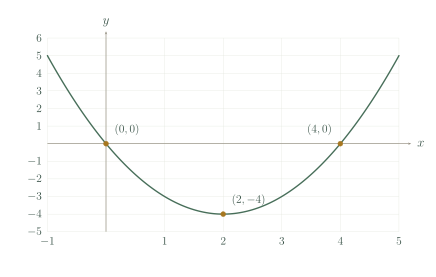
Find intercepts and vertex of .
Worked solution
- 1
Factor to find the horizontal-axis intercepts.
Each zero factor gives one horizontal-axis intercept, at the origin and at four.
- 2
Check the vertical-axis intercept.
The origin is also the vertical-axis intercept because its input is zero.
- 3
Find the symmetry axis between the roots.
The two roots lie equally far from the parabola’s symmetry axis.
- 4
Evaluate the vertex output.
Substitution at the symmetry axis gives the vertex; the positive coefficient makes it a minimum.
Intercepts (0,0),(4,0); vertex (2,-4).
Try it yourself.
Check your understanding
Find the vertex of .
Show answer & reasoning
(-2,7), a maximum.
The bracket vanishes at , giving output . Since , the vertex is a maximum.
Keep practising
6 worksheet questions · 14 marks
Read the questions online
- State vertex/axis for .2 marks
- Find the y-intercept of .2 marks
- Find x-intercepts of .2 marks
- Find the vertex of .2 marks
- Sketch , labelling vertex/intercepts.4 marks
- Give domain/range of for real .2 marks
Read the worked solutions
Equivalent correct methods earn the corresponding marks. Include units where asked.
- State vertex/axis for .2 marks
Read square form.
Vertex ; axis . - Find the y-intercept of .2 marks
At , .
- Find x-intercepts of .2 marks
Set .
Then is plus/minus 3.
, - Find the vertex of .2 marks
Rewrite as .
- Sketch , labelling vertex/intercepts.4 marks
Solve .
Use symmetry .
Vertex ; roots ,; opens downward. - Give domain/range of for real .2 marks
The square is nonnegative.
Its minimum is zero at .
Domain all real numbers; range .
Curriculum reference & lesson scope
SACE Board of South Australia
Stage 1 Mathematics topics 2.1–2.2: quadratic relationships, cubic and quartic polynomials. Original Ascent teaching sequence.
Official curriculum source ↗