
Understand the idea.
Gradient measures a rate
For a non-vertical line, gradient is vertical change divided by horizontal change. Subtract coordinates in the same point order in numerator and denominator. Its sign records whether output rises or falls as the input increases.
A horizontal line has zero gradient; a vertical line has undefined gradient because its horizontal change is zero. Calculate from coordinates, since unequal axis scales can distort apparent steepness. In a model, gradient has units of output per unit of input.
Intersections with axes
An intercept is a point where the graph meets an axis. On the horizontal axis ; on the vertical axis . Substitute these conditions separately and report the resulting coordinate pairs.
In , the gradient is and the vertical-axis intercept is . A line may lack one intercept: for example, never reaches the horizontal axis. Do not assume every line crosses both axes once.
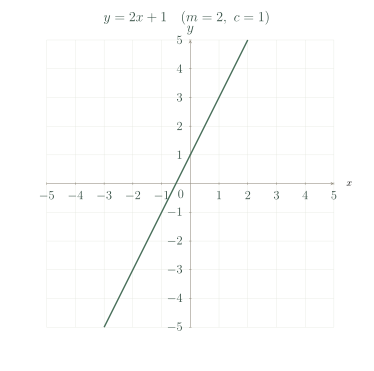
See the method in action.
Two points
Find the gradient of the line through and .
Worked solution
- 1
Calculate changes in a consistent order.
Both differences describe movement from the first point to the second.
- 2
Divide vertical change by horizontal change.
Six units to the right correspond to twelve units downward.
- 3
Interpret the rate.
Along this line, each unit increase in input decreases the output by two.
Both intercepts
Find the intercepts of .
Worked solution
- 1
Set the vertical coordinate to zero.
Every point on the horizontal axis has zero y-coordinate.
- 2
State the horizontal-axis intercept.
An intercept is a coordinate pair identifying the point on the axis.
- 3
Set the horizontal coordinate to zero.
Every point on the vertical axis has zero x-coordinate.
- 4
State the vertical-axis intercept.
The calculated output belongs to the input zero.
x-intercept (4,0); y-intercept (0,6).
Try it yourself.
Check your understanding
What are the gradient and y-intercept of ?
Show answer & reasoning
Gradient -4; y-intercept (0,7).
Comparing with gives and . The vertical-axis intercept is the point .
Keep practising
6 worksheet questions · 13 marks
Read the questions online
- Find the gradient through and .2 marks
- Find the gradient through and .2 marks
- Find both intercepts of .2 marks
- State the gradient of and the gradient of .2 marks
- In , where is dollars and is hours, interpret the gradient.2 marks
- A line passes through and . Find its x-intercept. Sketch the line and label both axis intercepts.3 marks
Read the worked solutions
Equivalent correct methods earn the corresponding marks. Include units where asked.
- Find the gradient through and .2 marks
.
- Find the gradient through and .2 marks
.
- Find both intercepts of .2 marks
For , . For , .
and . - State the gradient of and the gradient of .2 marks
A horizontal line has no vertical change. A vertical line has zero horizontal change, so the ratio is undefined.
0; undefined. - In , where is dollars and is hours, interpret the gradient.2 marks
Each extra hour adds 2.4 dollars.
2.40 dollars per hour. - A line passes through and . Find its x-intercept. Sketch the line and label both axis intercepts.3 marks
The gradient is , so .
Set to get .
.
Curriculum reference & lesson scope
SACE Board of South Australia
Stage 1 Mathematics, Topic 1: Functions and graphs. Prerequisite algebra and coordinate geometry are embedded as supporting lessons.
Official curriculum source ↗