
Understand the idea.
The part along a direction
A scalar projection is the signed amount of one vector along a chosen direction. Dotting with the unit vector gives this amount. Its sign tells whether that component follows or opposes the chosen direction.
The vector projection includes the direction as well as the amount. Multiply the signed scalar projection by the same unit vector, giving a denominator . Only the direction vector must be non-zero.
The leftover is perpendicular
The projected vector is the parallel part of . Subtract it from to obtain the perpendicular remainder. Check the decomposition in two ways: the parts must add back to , and the remainder must have dot product zero with .
Use the vector being projected onto in the denominator. Reversing that direction reverses the signed scalar projection but leaves the vector projection unchanged. The projected vector's magnitude is the absolute value of the scalar projection.
See the method in action.
Projection on a diagonal direction
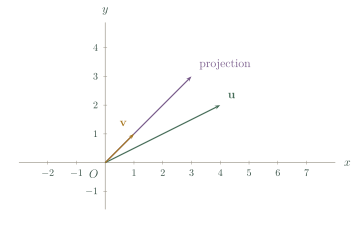
Find the scalar and vector projections of u=(4,2) onto v=(1,1).
Worked solution
- 1
Calculate the shared dot product and direction length.
The chosen direction is the vector being projected onto.
- 2
Calculate the signed scalar projection.
Dividing by the direction length gives the component along a unit direction.
- 3
Calculate the vector projection.
The vector projection multiplies the direction vector by the dot product divided by its squared length.
- 4
Check the perpendicular remainder.
Removing the parallel component must leave a vector perpendicular to the chosen direction.
Scalar ; vector .
A negative component
Find the projection of a=(-3,4) onto b=(1,0), then its perpendicular remainder.
Worked solution
- 1
Find the signed component along the given unit direction.
The direction vector is already a unit vector, and the horizontal component opposes it.
- 2
Restore the direction to obtain the vector projection.
A negative scalar sends the projected vector opposite to the positive horizontal direction.
- 3
Subtract the parallel part.
The remainder contains the part not accounted for by the parallel projection.
- 4
Verify perpendicularity.
The remaining vector is perpendicular to the direction of projection.
Parallel component ; perpendicular component .
Try it yourself.
Check your understanding
Project onto the y-axis direction .
Show answer & reasoning
.
The direction is a unit vector and . The vector projection is therefore ; the discarded horizontal part is perpendicular to the axis.
Keep practising
6 worksheet questions · 16 marks
Read the questions online
- Find the scalar projection of onto .2 marks
- Find the vector projection of onto .2 marks
- Project onto .2 marks
- Resolve into components parallel and perpendicular to .3 marks
- Find the scalar projection of onto and the length of the projected vector.3 marks
- Show that replacing by does not change .4 marks
Read the worked solutions
Equivalent correct methods earn the corresponding marks. Include units where asked.
- Find the scalar projection of onto .2 marks
The direction has length one and the dot product is three.
. - Find the vector projection of onto .2 marks
.
Multiply by .
. - Project onto .2 marks
The dot product is six and squared direction length is two.
. - Resolve into components parallel and perpendicular to .3 marks
Calculate the projection, then subtract it.
Check .
Parallel ; perpendicular . - Find the scalar projection of onto and the length of the projected vector.3 marks
The dot product is , divided by direction length .
Take the absolute value only for the length.
Scalar ; length . - Show that replacing by does not change .4 marks
The numerator doubles, the denominator quadruples and the final direction vector doubles.
The factors cancel.
Both give .
Curriculum reference & lesson scope
SACE Board of South Australia
Stage 1 Mathematics: vectors in the plane. Covers magnitude, components, geometry, scalar products, projections and proofs; follows the approved Specialist preparation structure.
Official curriculum source ↗