
Understand the idea.
Images of the basis vectors
The standard unit vectors select the columns: is the first column and the second. Since , linearity gives , a weighted sum of those column images.
To construct a linear map from unit-vector images, place the image of in column 1 and the image of in column 2. This determines every output, not only the two stated images.
Map every vertex consistently
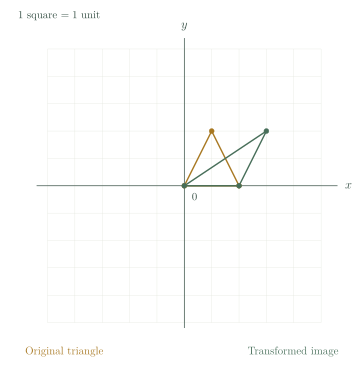
Transform a polygon by applying the same matrix to each vertex, then joining the images in the original order. Straight edges remain straight or collapse to points, although lengths and angles may change.
The retained diagram shows the map . The added horizontal displacement depends on height, so this is not a translation. Calculate the vertex images to check the sketch rather than relying on appearance alone.
See the method in action.
Read the columns
For , find , and the image of .
Worked solution
- 1
Read the first unit-vector image.
Multiplication by selects column 1.
- 2
Read the second unit-vector image.
Multiplication by selects column 2.
- 3
Express the point using the unit vectors.
The input coordinates specify the weights of the two basis vectors.
- 4
Apply the same weights to their images.
Linearity distributes the transformation across the weighted sum.
Unit-vector images and ; point image .
Construct a matrix
A linear map sends to and to . Find its matrix and the image of .
Worked solution
- 1
Put the given images into columns.
The first column is the image of ; the second is the image of .
- 2
Multiply by the requested input.
Each output coordinate is a row-column dot product.
- 3
Simplify the image coordinates.
The two basis images contribute once and twice respectively.
, image .
Try it yourself.
Check your understanding
What is the image of under ?
Show answer & reasoning
.
The input selects the second column, so its image is . Equivalently, the first column has weight 0 and the second column has weight 1.
Keep practising
6 worksheet questions · 12 marks
Read the questions online
- Find the image of under .2 marks
- Write the matrix sending to and to .2 marks
- Apply to .2 marks
- Apply to the vertices .2 marks
- Find the matrix for .2 marks
- A map sends to and to . Find the image of .2 marks
Read the worked solutions
Equivalent correct methods earn the corresponding marks. Include units where asked.
- Find the image of under .2 marks
Multiply row by column to get .
. - Write the matrix sending to and to .2 marks
Use the images as columns.
. - Apply to .2 marks
The rule sends to .
. - Apply to the vertices .2 marks
Apply the same rule to every vertex.
. - Find the matrix for .2 marks
Coefficients of give column 1; coefficients of give column 2.
. - A map sends to and to . Find the image of .2 marks
Use three times the first image minus twice the second.
.
Curriculum reference & lesson scope
SACE Board of South Australia
Stage 1 Mathematics: matrices and transformations; original lessons follow the approved school-sized chapter structure.
Official curriculum source ↗