
Understand the idea.
Radians describe arc length
A radian measures angle by arc length divided by radius. One full turn is radians, equivalent to . Convert a degree angle by multiplying by , keeping for an exact value.
The formulas and require in radians. Arc length has the same length units as the radius; sector area has squared units. Convert the angle before substituting the radius.
Coordinates explain signs
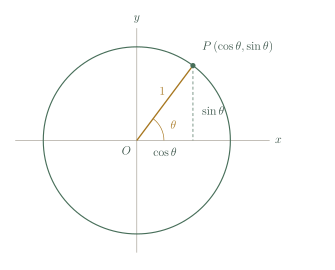
The point at angle on the unit circle is . Cosine is horizontal position and sine is vertical position, so the quadrant determines their signs. Tangent is their ratio wherever cosine is nonzero.
Use a first-quadrant reference angle to find exact magnitudes, then apply the actual quadrant signs. Adding preserves sine and cosine; adding preserves tangent. Tangent is undefined where the unit-circle horizontal coordinate is zero.
See the method in action.
Example 1
Find and exactly.
Worked solution
- 1
Locate the angle and reference angle.
The angle lies in quadrant II and has reference angle .
- 2
Use the positive vertical coordinate.
Sine is positive in quadrant II.
- 3
Use the negative horizontal coordinate.
Cosine is negative in quadrant II.
and .
Example 2
A radius-6 cm circle has a sector angle of . Find the arc length and sector area.
Worked solution
- 1
Convert the sector angle to radians.
The arc and sector formulas use radian measure.
- 2
Calculate the arc length.
Arc length equals radius multiplied by radian angle.
- 3
Calculate the sector area.
The sector occupies the fraction of the full circle area.
Arc cm; sector area cm.
Try it yourself.
Check your understanding
Find exactly.
Show answer & reasoning
.
is in quadrant IV, with sine and cosine . Their ratio is .
Keep practising
6 worksheet questions · 12 marks
Read the questions online
- Convert to radians.2 marks
- Convert radians to degrees.2 marks
- Find exactly.2 marks
- Find exactly.2 marks
- Find the arc length for radius 8 m and angle .2 marks
- Explain why tangent is undefined at .2 marks
Read the worked solutions
Equivalent correct methods earn the corresponding marks. Include units where asked.
- Convert to radians.2 marks
.
. - Convert radians to degrees.2 marks
.
. - Find exactly.2 marks
Quadrant III gives negative sine; the reference angle is .
. - Find exactly.2 marks
Cosine is even, so this equals .
. - Find the arc length for radius 8 m and angle .2 marks
.
m. - Explain why tangent is undefined at .2 marks
, ; division by zero is undefined.
Its cosine denominator is zero.
Curriculum reference & lesson scope
SACE Board of South Australia
Stage 1 Mathematics, Further Trigonometry: periodic functions and models, trigonometric identities and reciprocal functions; the Library sequence follows the approved school-topic structure.
Official curriculum source ↗