
Understand the idea.
Addition is a two-component translation
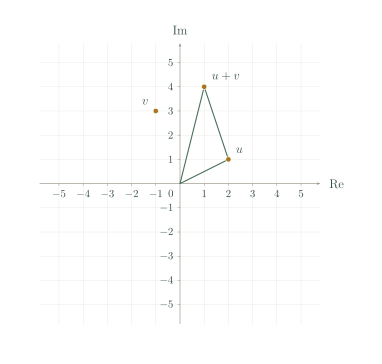
Complex addition is vector addition in two real components. To construct , draw the displacement for beginning at the endpoint of the vector for . The endpoint represents the sum; its position vector from the origin is the resultant.
Subtraction adds an opposite vector. The displacement from point to point is always . Its real part measures horizontal movement and its imaginary coefficient measures vertical movement, so component arithmetic checks the geometric construction.
Conjugation and real scalar multiplication
Conjugation reflects a point in the real axis, preserving horizontal position and distance from the origin. Applying the reflection twice returns the original point: . A point and its conjugate therefore have a midpoint on the real axis.
Multiplying by a real scalar multiplies both components. Positive preserves direction, negative reverses it, and zero sends every point to the origin. Distances scale by , while midpoint coordinates come from averaging the corresponding components.
See the method in action.
Add using two representations
Let and . Find and describe its construction.
Worked solution
- 1
Add the real and imaginary components.
Like components add independently.
- 2
Place the second displacement at the first endpoint.
From the endpoint of u, move one unit left and three units upward.
- 3
Identify the resultant vector.
The vector from the origin to the final endpoint represents .
.
Find a reflected midpoint
Let . Find the midpoint of the points and .
Worked solution
- 1
Find the reflected point.
Conjugation keeps the real coordinate and reverses the imaginary coordinate.
- 2
Average the two complex positions.
A midpoint averages the horizontal and vertical coordinates separately.
- 3
Interpret its location.
The opposite imaginary components cancel, leaving the midpoint on the real axis.
.
Try it yourself.
Check your understanding
What translation maps to ?
Show answer & reasoning
Three units right and two units down.
Adding adds displacement to every point. This moves the point three units right and two units down.
Keep practising
6 worksheet questions · 18 marks
Read the questions online
- Find and for and .3 marks
- Find the vector from to .2 marks
- Find the midpoint between and .3 marks
- Describe the effect of multiplying all complex numbers by .3 marks
- Prove is real and has real part zero for every complex .4 marks
- A parallelogram has successive vertices , , , . For and , find its centre.3 marks
Read the worked solutions
Equivalent correct methods earn the corresponding marks. Include units where asked.
- Find and for and .3 marks
Add or subtract the two real components and the two imaginary components.
; . - Find the vector from to .2 marks
.
. - Find the midpoint between and .3 marks
Average components: and .
. - Describe the effect of multiplying all complex numbers by .3 marks
Both coordinates double in magnitude and reverse sign.
A dilation by factor about the origin followed by a half-turn. - Prove is real and has real part zero for every complex .4 marks
Write the conjugate as .
Add and subtract componentwise; each result has the required zero component.
If , the expressions are and . The second is pure imaginary when , and is zero when . - A parallelogram has successive vertices , , , . For and , find its centre.3 marks
The opposite vertices and have midpoint .
Diagonals of a parallelogram share their midpoint.
.
Curriculum reference & lesson scope
SACE Board of South Australia
Stage 1 Mathematics, real and complex numbers: Cartesian arithmetic, conjugates, quadratic roots and Argand geometry. Polar form and roots of unity are developed in Year 12.
Official curriculum source ↗