
Understand the idea.
Identify vertical and horizontal changes
For a nonconstant sinusoid , with and , amplitude is and the midline is . Its range is . A negative reflects the sinusoid in its midline.
The period of this nonconstant sinusoid is . Factor before reading the shift: shifts right by . If or , the rule is instead constant at , with range and no fundamental period.
Sketch and construct
Locate a convenient starting phase, then mark points a quarter-period apart. Positive sine starts at a rising midline crossing; positive cosine starts at a maximum. The illustrated graph also has the equivalent form .
To construct a model, average the maximum and minimum for the midline and halve their difference for amplitude. Measure the period between corresponding points, such as consecutive maxima. Then choose a phase that places a known crossing or extremum correctly.
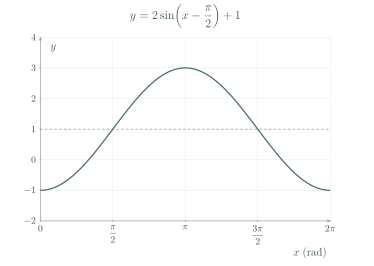
See the method in action.
Example 1
Describe .
Worked solution
- 1
Read the vertical features.
Cosine ranges from to , giving amplitude , midline and range .
- 2
Calculate the period.
Multiplying the input by two halves the usual cosine period.
- 3
Read the phase from the factored argument.
The shift is right by ; positive cosine has its maximum at zero argument.
Amplitude 3; period ; shift right ; range .
Example 2
A sinusoid has maximum 7, minimum 1 and consecutive maxima at and . Give a cosine rule.
Worked solution
- 1
Calculate midline and amplitude.
The midpoint of the extremes is the midline, and their half-difference is the amplitude.
- 2
Calculate the frequency coefficient.
Consecutive maxima are one full period apart.
- 3
Place a maximum at the given input.
At and the arguments are and , so both are maxima of height .
.
Try it yourself.
Check your understanding
What is the period of ?
Show answer & reasoning
.
The input coefficient is , so . The factor changes amplitude and orientation, and shifts the midline; neither changes the period.
Keep practising
6 worksheet questions · 12 marks
Read the questions online
- State the amplitude and range of .2 marks
- Find the period of .2 marks
- Find the horizontal shift of .2 marks
- A cosine graph has range , period and a maximum at 0. Give a rule.2 marks
- Find the first two maxima of for .2 marks
- Explain the difference between and .2 marks
Read the worked solutions
Equivalent correct methods earn the corresponding marks. Include units where asked.
- State the amplitude and range of .2 marks
The midline is ; add and subtract 4.
Amplitude 4; range . - Find the period of .2 marks
, so .
. - Find the horizontal shift of .2 marks
Factor the argument as .
Right . - A cosine graph has range , period and a maximum at 0. Give a rule.2 marks
The mean of the endpoints is , half their difference is 4, and .
. - Find the first two maxima of for .2 marks
Period 6; positive cosine starts at a maximum.
. - Explain the difference between and .2 marks
Their ranges are and , respectively.
The first changes the midline; the second changes amplitude.
Curriculum reference & lesson scope
SACE Board of South Australia
Stage 1 Mathematics, Further Trigonometry: periodic functions and models, trigonometric identities and reciprocal functions; the Library sequence follows the approved school-topic structure.
Official curriculum source ↗