
Understand the idea.
Keep one component, discard the other
Orthogonal projection onto the -axis keeps the horizontal coordinate and replaces the vertical coordinate with zero: . Onto the -axis it gives . The removed displacement is perpendicular to the target axis.
Projection and reflection behave differently. Projection discards the perpendicular component; reflection reverses it. Points on the target axis are fixed by both maps, but points off that axis distinguish the two.
Projection is idempotent
The coordinate projection matrices keep one component and remove the other. Applying the same projection twice changes nothing further: and . This property is called idempotence.
A coordinate projection is singular because many inputs share the same retained component. The diagram shows the triangle collapsing onto the -axis; the output alone cannot recover the original vertical coordinates, so no inverse exists.
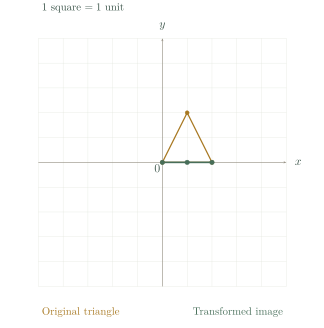
See the method in action.
Two coordinate projections
Project onto the x-axis and onto the y-axis.
Worked solution
- 1
Write the two projection matrices.
The diagonal 1 keeps a coordinate and the zero row removes the other.
- 2
Project the first point onto the horizontal axis.
The horizontal coordinate stays 3 while the vertical component is discarded.
- 3
Project the second point onto the vertical axis.
The vertical coordinate stays 5 while the horizontal component is discarded.
and .
Combine projections
Find and .
Worked solution
- 1
Add corresponding entries.
The two separate projections supply the horizontal and vertical components respectively.
- 2
Multiply in the stated order.
Every row-column dot product is zero.
- 3
Interpret the product on any point.
Keeping only the vertical component first leaves no horizontal component for the second projection to retain.
and .
Try it yourself.
Check your understanding
Find .
Show answer & reasoning
.
removes the horizontal component and keeps the vertical one. Therefore ; the negative sign on the retained coordinate remains unchanged.
Keep practising
6 worksheet questions · 12 marks
Read the questions online
- Give the matrix for projection onto the -axis.2 marks
- Find .2 marks
- Find all points whose -axis projection is .2 marks
- Calculate .2 marks
- Explain why a coordinate projection has no inverse.2 marks
- Compare the -axis projection and -axis reflection of .2 marks
Read the worked solutions
Equivalent correct methods earn the corresponding marks. Include units where asked.
- Give the matrix for projection onto the -axis.2 marks
The unit-vector images are and .
. - Find .2 marks
Keep and remove .
. - Find all points whose -axis projection is .2 marks
The -coordinate must be 2; the -coordinate is unrestricted.
for any real . - Calculate .2 marks
Multiply the two diagonal projection matrices.
The surviving diagonal entry remains 1.
. - Explain why a coordinate projection has no inverse.2 marks
Many inputs have the same image, and the determinant is zero.
It loses one coordinate. - Compare the -axis projection and -axis reflection of .2 marks
Projection discards ; reflection reverses .
Projection ; reflection .
Curriculum reference & lesson scope
SACE Board of South Australia
Stage 1 Mathematics: matrices and transformations; original lessons follow the approved school-sized chapter structure.
Official curriculum source ↗