
Understand the idea.
Reciprocal is not inverse
A reciprocal trig function takes the reciprocal of a ratio: secant uses cosine, cosecant uses sine, and cotangent is cosine divided by sine. This differs from an inverse trig function, which returns an angle from a ratio.
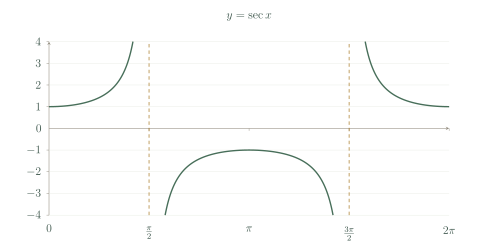
Exclude every zero of the original denominator. Secant excludes , while cosecant and cotangent exclude , for integers . Near those excluded values the graphs have vertical asymptotes; the function has no value on an asymptote.
Sketch separate branches
Taking the reciprocal of a nonzero sine or cosine produces magnitude at least one. Thus secant and cosecant have range and period . Their vertices occur where the original ratio equals or .
Cotangent has range , period and zeros where cosine vanishes but sine does not. Sketch each branch separately across asymptotes. For equations, convert to sine or cosine while retaining the original nonzero-denominator restriction.
See the method in action.
Example 1
State the domain and range of .
Worked solution
- 1
Exclude the zeros of cosine.
Secant equals , so its denominator must be nonzero.
- 2
Bound the reciprocal magnitude.
Taking reciprocals of positive magnitudes reverses this inequality.
- 3
Check endpoints and state the range.
The endpoint values occur, and the continuous branches grow without bound near cosine zeros.
Domain excludes , ; range .
Example 2
Solve on .
Worked solution
- 1
Record the original restriction.
Cosecant is defined only when its sine denominator is nonzero.
- 2
Rewrite in terms of sine.
Multiplication by the nonzero sine is valid on the original domain.
- 3
Find and check both branches.
Both quadrant I and II values lie in and have nonzero sine, so both solve the original equation.
.
Try it yourself.
Check your understanding
Where is ?
Show answer & reasoning
, .
For to vanish, cosine must be zero and sine must be nonzero. This occurs at , with .
Keep practising
6 worksheet questions · 12 marks
Read the questions online
- Find .2 marks
- Find .2 marks
- State the excluded values for .2 marks
- Solve on .2 marks
- State the range of .2 marks
- Find the period and zeros of .2 marks
Read the worked solutions
Equivalent correct methods earn the corresponding marks. Include units where asked.
- Find .2 marks
Take the reciprocal of .
2. - Find .2 marks
The sine is ; its reciprocal is .
-2. - State the excluded values for .2 marks
Exclude , giving .
, . - Solve on .2 marks
Take reciprocals to solve .
. - State the range of .2 marks
Scale secant by 2 and shift both branches up 1.
. - Find the period and zeros of .2 marks
Cotangent repeats when its argument increases by ; its zeros occur at argument .
Period ; zeros .
Curriculum reference & lesson scope
SACE Board of South Australia
Stage 1 Mathematics, Further Trigonometry: periodic functions and models, trigonometric identities and reciprocal functions; the Library sequence follows the approved school-topic structure.
Official curriculum source ↗