
Understand the idea.
A directed change
A vector describes a directed change. Moving three metres east and four metres north gives components : the signs record the horizontal and vertical directions. Its magnitude measures the straight-line displacement, rather than the distance travelled along a route.
The component triangle is right-angled, so its hypotenuse has length . In general, square both components, add, then take the non-negative square root. Opposite vectors have the same magnitude.
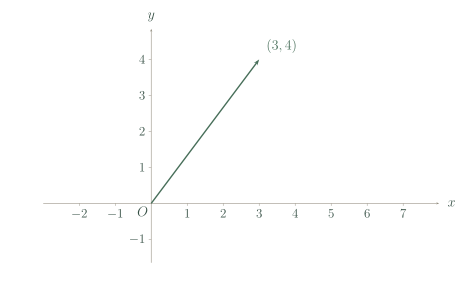
Choose the quadrant before using a calculator
First use the component signs to locate the quadrant. Then use trigonometry to find a reference angle and place it in that quadrant. Unless stated otherwise, measure direction anticlockwise from the positive -axis, between and .
On an axis, read the direction directly instead of dividing by a zero component. The zero vector has no unique direction. Keep magnitudes exact where possible; round an angle only at the final step.
See the method in action.
Magnitude and a first-quadrant direction
Find the magnitude and direction of ; give the direction to .
Worked solution
- 1
Find the length.
The components are perpendicular sides of a right triangle.
- 2
Locate the direction.
Positive horizontal and vertical components place the vector in quadrant I.
- 3
Calculate and round the angle.
In quadrant I, the reference angle is the direction from the positive horizontal axis.
Magnitude ; direction .
A north-west displacement
A walker has displacement km. Give its exact magnitude and direction from the positive x-axis.
Worked solution
- 1
Calculate the exact magnitude.
Squaring removes the component signs when calculating length.
- 2
Find the reference angle.
The absolute horizontal and vertical changes are equal.
- 3
Place the angle in quadrant II.
The negative horizontal component points west and the positive vertical component points north.
km at .
Try it yourself.
Check your understanding
What are the magnitude and direction of ?
Show answer & reasoning
Magnitude ; direction .
. A zero horizontal component and negative vertical component point straight down the negative -axis, whose anticlockwise direction is .
Keep practising
6 worksheet questions · 15 marks
Read the questions online
- Find the magnitude of .2 marks
- Find the exact magnitude and direction of .2 marks
- A displacement is m. Find its magnitude and its direction south of east to .3 marks
- A non-zero vector has magnitude and direction . Find its exact components.3 marks
- Find if has magnitude .3 marks
- Explain why cannot be assigned a unique direction angle.2 marks
Read the worked solutions
Equivalent correct methods earn the corresponding marks. Include units where asked.
- Find the magnitude of .2 marks
.
- Find the exact magnitude and direction of .2 marks
The magnitude is .
A quadrant-II arrow with equal component sizes makes angle .
and . - A displacement is m. Find its magnitude and its direction south of east to .3 marks
.
.
m; south of east. - A non-zero vector has magnitude and direction . Find its exact components.3 marks
Horizontal component: .
Vertical component: .
. - Find if has magnitude .3 marks
, so .
Both horizontal directions have the required magnitude.
or . - Explain why cannot be assigned a unique direction angle.2 marks
Every angle would produce the same zero displacement when the magnitude is zero.
It represents no directed movement, so no direction is distinguished.
Curriculum reference & lesson scope
SACE Board of South Australia
Stage 1 Mathematics: vectors in the plane. Covers magnitude, components, geometry, scalar products, projections and proofs; follows the approved Specialist preparation structure.
Official curriculum source ↗