
Understand the idea.
A fixed pair of directions
The standard basis vectors and each have length one and are perpendicular. Multiplying them by signed numbers describes the horizontal and vertical changes separately; adding those changes reconstructs the vector.
In , the coefficient always comes first in the ordered pair, even if the terms were written in a different order. Here is a direction vector, rather than the imaginary unit.
Unit vectors point rather than measure distance
To normalise a non-zero vector, divide it by its magnitude. This changes its length to one without changing its direction, because the divisor is positive. Check a proposed unit vector by verifying that its squared components sum to one.
There are two unit vectors parallel to a given non-zero vector: the normalised vector and its opposite. The wording “in the direction of” selects the first. The zero vector cannot be normalised because division by its magnitude would divide by zero.
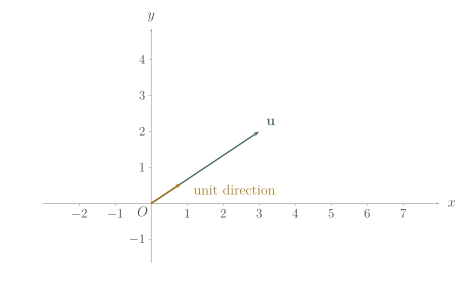
See the method in action.
Changing notation
Write as an ordered pair, then find its magnitude.
Worked solution
- 1
Read the horizontal and vertical coefficients.
Reordering addition does not change the vector.
- 2
Write the components in axis order.
The first entry is the coefficient of the horizontal basis vector.
- 3
Find its magnitude.
The perpendicular components form a right triangle.
; magnitude .
Normalising a vector
Find a unit vector in the direction of .
Worked solution
- 1
Find the length of the given vector.
Normalisation requires the magnitude, rather than the sum of the components.
- 2
Divide each component by that length.
Dividing by a positive magnitude preserves the original direction.
- 3
Verify the unit length.
A vector with squared magnitude one has magnitude one.
.
Try it yourself.
Check your understanding
Find the unit vector in the direction of .
Show answer & reasoning
.
The magnitude is . Therefore , which retains the downward direction and has length one.
Keep practising
6 worksheet questions · 14 marks
Read the questions online
- Write in basis-vector notation.2 marks
- Write as an ordered pair.2 marks
- Find a unit vector in the direction of .2 marks
- Find both unit vectors parallel to .3 marks
- Find if is a unit vector.3 marks
- Explain why normalising the zero vector is impossible.2 marks
Read the worked solutions
Equivalent correct methods earn the corresponding marks. Include units where asked.
- Write in basis-vector notation.2 marks
The first component multiplies and the second multiplies .
. - Write as an ordered pair.2 marks
Read coefficients in -then- order.
. - Find a unit vector in the direction of .2 marks
The magnitude is .
Divide both components by .
. - Find both unit vectors parallel to .3 marks
The vector has magnitude .
Normalise and then take its opposite.
. - Find if is a unit vector.3 marks
gives .
Both vertical signs give length one.
or . - Explain why normalising the zero vector is impossible.2 marks
The magnitude of the zero vector is zero, so the normalisation formula is undefined.
It would require division by zero and there is no unique direction.
Curriculum reference & lesson scope
SACE Board of South Australia
Stage 1 Mathematics: vectors in the plane. Covers magnitude, components, geometry, scalar products, projections and proofs; follows the approved Specialist preparation structure.
Official curriculum source ↗