
Understand the idea.
Test a standard transformation
Use coordinate rules to recognise standard maps about the origin. Reflection in the -axis sends to ; reflection in sends it to . A point on the mirror line must remain fixed.
A dilation of factor about the origin has matrix : every position vector is multiplied by . For a rotation about another centre, first translate that centre to the origin, rotate, and translate back.
A counterclockwise rotation
For a counterclockwise angle , the unit-vector images are and . Placing these in columns gives the rotation matrix below. A negative angle describes a clockwise rotation.
Check the direction using the positive -axis: a counterclockwise rotation sends to . Thus a quarter-turn has rule ; a sketch should agree with the computed coordinates.
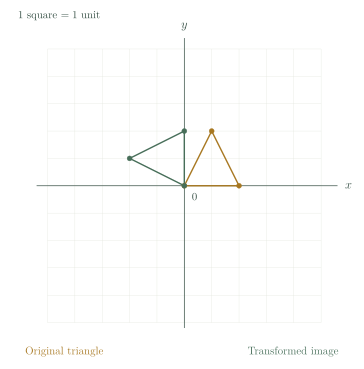
See the method in action.
A quarter-turn
Rotate through counterclockwise.
Worked solution
- 1
Substitute the quarter-turn angle.
The positive -axis turns to the positive -axis.
- 2
Write the counterclockwise rotation matrix.
The columns are the rotated images of the two unit vectors.
- 3
Apply it to the point.
The coordinate rule is , so the negative original height becomes positive horizontal position.
.
A reflection and a dilation
Reflect in , then dilate by factor 2.
Worked solution
- 1
Reflect by swapping coordinates.
Reflection in exchanges horizontal and vertical coordinates.
- 2
Dilate the reflected point by 2.
Dilation about the origin multiplies both components by the same factor.
- 3
Combine the matrices in action order.
The reflection acts first, so its factor is rightmost.
- 4
Check the combined map.
The single product agrees with the two successive transformations.
; combined matrix .
Try it yourself.
Check your understanding
Give the matrix for a rotation.
Show answer & reasoning
.
A turn sends both unit vectors to their negatives. Its columns are and , giving and the rule .
Keep practising
6 worksheet questions · 12 marks
Read the questions online
- Give the matrix for reflection in the -axis.2 marks
- Rotate through clockwise.2 marks
- Give the matrix for dilation of factor .2 marks
- Reflect in .2 marks
- Rotate through counterclockwise using exact values.2 marks
- Describe the transformation .2 marks
Read the worked solutions
Equivalent correct methods earn the corresponding marks. Include units where asked.
- Give the matrix for reflection in the -axis.2 marks
Change the sign but keep .
. - Rotate through clockwise.2 marks
Use to .
. - Give the matrix for dilation of factor .2 marks
Multiply both coordinates by .
. - Reflect in .2 marks
Swap the coordinates.
. - Rotate through counterclockwise using exact values.2 marks
Use and .
. - Describe the transformation .2 marks
It sends to .
Every point on that mirror line is fixed.
Reflection in .
Curriculum reference & lesson scope
SACE Board of South Australia
Stage 1 Mathematics: matrices and transformations; original lessons follow the approved school-sized chapter structure.
Official curriculum source ↗