
Understand the idea.
Equal arrows can start in different places
Think of a free vector as an instruction for moving: the same horizontal change and the same vertical change give the same vector wherever you start. Thus equal vectors have matching components, as well as equal magnitude and direction.
To obtain , subtract the coordinates of from those of . The order follows the arrow: end minus start. Comparing the two component changes is more reliable than estimating arrows from a sketch.
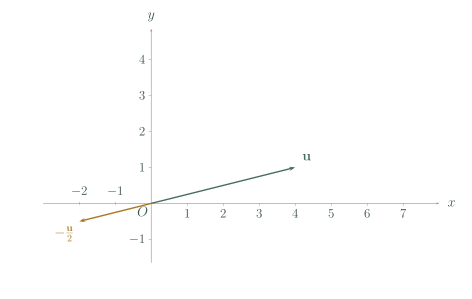
Reversing a directed segment
The opposite vector undoes the original movement. Negate every component, so travelling along and then returns to the start. Reversing the endpoints gives .
Negating a vector preserves its length but reverses its direction. Equal length alone therefore does not establish vector equality. Only equals its own opposite, since implies .
See the method in action.
Equal vectors from coordinates
Let , , and . Compare and .
Worked solution
- 1
Calculate the first displacement.
Subtract the starting coordinates from the ending coordinates.
- 2
Calculate the second displacement.
Subtracting a negative coordinate adds its positive value.
- 3
Compare both components.
Both arrows move three units right and four units up, even though they start at different points.
, although the arrows start at different points.
Finding an endpoint of an opposite arrow
Let , and . Find if .
Worked solution
- 1
Find the original displacement.
The arrow runs from P to Q.
- 2
Reverse the displacement.
An opposite vector reverses both component changes.
- 3
Add the change to the new start.
An endpoint equals its starting point plus the required displacement.
.
Try it yourself.
Check your understanding
If , what is ?
Show answer & reasoning
.
Negate both components: . Changing only one sign would reflect the arrow rather than reverse it.
Keep practising
6 worksheet questions · 14 marks
Read the questions online
- Find the opposite of .2 marks
- Are and equal vectors? Explain.2 marks
- If , find and .2 marks
- Let and . Find both and .3 marks
- A vector equal to starts at . Find its endpoint.2 marks
- Solve and explain the result.3 marks
Read the worked solutions
Equivalent correct methods earn the corresponding marks. Include units where asked.
- Find the opposite of .2 marks
Negate each component.
. - Are and equal vectors? Explain.2 marks
Their components differ, even though both magnitudes are .
No. - If , find and .2 marks
Equate components: and .
, . - Let and . Find both and .3 marks
Subtract the start from the end for each arrow.
The answers are opposites.
and . - A vector equal to starts at . Find its endpoint.2 marks
Add the component changes to the starting coordinates.
. - Solve and explain the result.3 marks
Adding to both sides gives .
Only zero has no distinction between a direction and its reverse.
.
Curriculum reference & lesson scope
SACE Board of South Australia
Stage 1 Mathematics: vectors in the plane. Covers magnitude, components, geometry, scalar products, projections and proofs; follows the approved Specialist preparation structure.
Official curriculum source ↗