
Understand the idea.
Rearranging the geometric dot product
To find the angle between two non-zero vectors, calculate their dot product and both magnitudes. Dividing the dot product by the product of those magnitudes removes their lengths, leaving only . Apply inverse cosine to find the included angle.
Use the angle in , with the calculator in degree mode when degrees are required. Retain exact roots until the final calculation. The cosine ratio must lie between and .
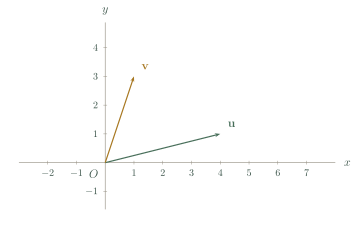
The arrow direction matters
Place the two arrows tail to tail when interpreting their included angle. Reversing one vector negates the dot product, so its angle becomes . Reversing both preserves the original angle.
An unoriented pair of intersecting lines has supplementary angles, so its smaller angle may differ from the angle between chosen arrows. If either vector is zero, no angle is defined: its direction is absent and the angle formula would divide by zero.
See the method in action.
An exact angle
Find the angle between and .
Worked solution
- 1
Calculate the dot product.
The dot product measures the component alignment.
- 2
Calculate both magnitudes.
The geometric dot-product formula uses the product of the lengths.
- 3
Find the cosine and select the included angle.
The unique angle in the included-angle range with cosine one half is sixty degrees.
.
An obtuse angle
Find the angle between and .
Worked solution
- 1
Calculate the signed dot product.
The negative result indicates an obtuse included angle.
- 2
Calculate the product of magnitudes.
Magnitudes are positive even when a vector has a negative component.
- 3
Find the included angle.
The negative cosine places the angle between ninety and one hundred eighty degrees.
.
Try it yourself.
Check your understanding
Find the angle between and .
Show answer & reasoning
.
and the magnitude product is . Thus , giving .
Keep practising
6 worksheet questions · 15 marks
Read the questions online
- Find the angle between and .2 marks
- Find the angle between and .2 marks
- Find the angle between and to .3 marks
- If the angle between non-zero vectors and is , find the angle between and .2 marks
- Can hold if and ? Explain.3 marks
- , , . Find angle to .3 marks
Read the worked solutions
Equivalent correct methods earn the corresponding marks. Include units where asked.
- Find the angle between and .2 marks
.
. - Find the angle between and .2 marks
The dot product is .
. - Find the angle between and to .3 marks
.
Take inverse cosine.
. - If the angle between non-zero vectors and is , find the angle between and .2 marks
Reversing changes cosine to its negative, giving .
. - Can hold if and ? Explain.3 marks
It would require .
The dot-product magnitude cannot exceed the product of the lengths.
No. - , , . Find angle to .3 marks
Use and .
.
.
Curriculum reference & lesson scope
SACE Board of South Australia
Stage 1 Mathematics: vectors in the plane. Covers magnitude, components, geometry, scalar products, projections and proofs; follows the approved Specialist preparation structure.
Official curriculum source ↗