
Understand the idea.
Adding arrows head to tail
Add successive displacements by placing arrows head to tail. The resultant goes directly from the original start to the final endpoint. Algebraically, add horizontal changes together and vertical changes together; the route and its resultant have the same net displacement.
A scalar multiplies every component. For a non-zero vector, a positive scalar preserves direction and a negative scalar reverses it; the length is multiplied by the scalar's absolute value. Multiplying by zero gives the zero vector.
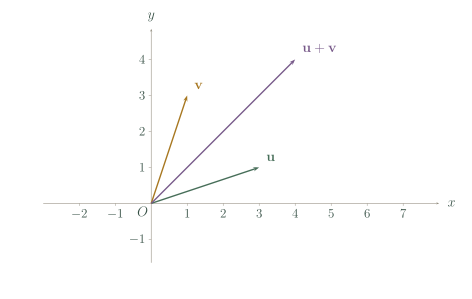
Subtraction is a displacement between arrowheads
Subtracting a vector means adding its opposite: . If both arrows share a tail, the arrow from the head of to the head of represents this difference.
Apply an outside minus sign to every component or term inside its brackets. For example, . Calculate scalar multiples first, then combine corresponding components, keeping brackets around negative numbers.
See the method in action.
A linear combination
Given and , find .
Worked solution
- 1
Scale the vectors separately.
Scalar multiplication acts on both components.
- 2
Subtract component by component.
Subtract the entire second vector, including its negative horizontal component.
- 3
Simplify the resultant.
The horizontal change is positive twelve and the vertical change is negative eleven.
.
A route and a return journey
A canoe travels km, then km. Find the total displacement and the direct return displacement.
Worked solution
- 1
Add the two journey legs.
Successive horizontal and vertical changes accumulate independently.
- 2
Find the displacement that cancels the journey.
The return arrow points from the final position back to the original start.
- 3
Check the completed round trip.
Returning to the starting position gives zero net displacement.
Total km; direct return km.
Try it yourself.
Check your understanding
Find .
Show answer & reasoning
.
, then . The vertical subtraction becomes addition because the component being subtracted is negative.
Keep practising
6 worksheet questions · 14 marks
Read the questions online
- For and , find .2 marks
- For the same vectors, find .2 marks
- Find .2 marks
- Solve .2 marks
- A drone flies km, then km, then km. Find its displacement and direct return vector.3 marks
- If , find and explain the direction.3 marks
Read the worked solutions
Equivalent correct methods earn the corresponding marks. Include units where asked.
- For and , find .2 marks
Add corresponding components.
. - For the same vectors, find .2 marks
and .
. - Find .2 marks
The scaled vectors are and .
Add them.
. - Solve .2 marks
.
Divide both components by .
. - A drone flies km, then km, then km. Find its displacement and direct return vector.3 marks
Add all three legs componentwise.
Negate the resultant for the return.
Displacement km; return km. - If , find and explain the direction.3 marks
Multiply the length by .
The negative scalar reverses direction.
; opposite to .
Curriculum reference & lesson scope
SACE Board of South Australia
Stage 1 Mathematics: vectors in the plane. Covers magnitude, components, geometry, scalar products, projections and proofs; follows the approved Specialist preparation structure.
Official curriculum source ↗