
Understand the idea.
Two axes for one number
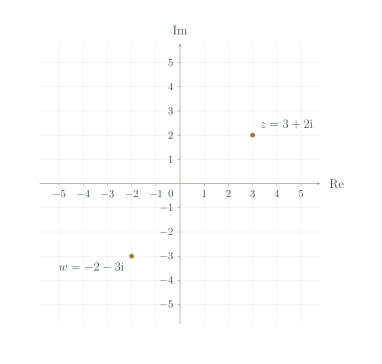
An Argand diagram plots at the point . The horizontal axis is the real part and the vertical axis is the imaginary part. Both coordinates are real numbers; do not place as the vertical coordinate.
The point also defines a position vector from the origin. Label the axes Re and Im, and use a consistent scale to interpret distances. A complex number on the horizontal axis has imaginary part zero.
Read geometric changes
Conjugation maps to , a reflection in the real axis. Negation maps to , a half-turn about the origin. Compare which coordinates change to distinguish these operations.
The displacement from to is : final point minus initial point. Its components give horizontal and vertical movement. Use Pythagoras for its length, and use the diagram to check the direction and signs.
See the method in action.
Plot and reflect
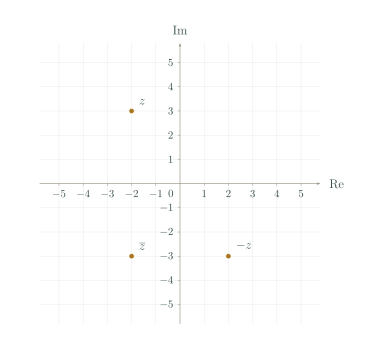
For , give coordinates for , and .
Worked solution
- 1
Read the original point.
The real coordinate is negative two and the imaginary coordinate is three.
- 2
Reflect by conjugating.
Reflection in the real axis reverses only the vertical coordinate.
- 3
Find the opposite point by negating.
A half-turn about the origin reverses both coordinates.
, and .
Find a displacement
Point represents and represents . Find the displacement from to and its length.
Worked solution
- 1
Subtract the initial point from the final point.
Displacement from A to B is final position minus initial position.
- 2
Read the movement components.
The movement is three units right and four units upward.
- 3
Calculate the displacement length.
The horizontal and vertical displacements are perpendicular.
Displacement ; length .
Try it yourself.
Check your understanding
What number is represented by on an Argand diagram?
Show answer & reasoning
.
The coordinates give real part negative four and imaginary coefficient two, so the represented complex number is .
Keep practising
6 worksheet questions · 17 marks
Read the questions online
- On an Argand diagram, plot , and . State their coordinates.3 marks
- A point is three units left of the origin and four units below it. Write the complex number.2 marks
- For , state the coordinates of and .3 marks
- Find the distance from to .3 marks
- A rectangle has vertices , , and . Find its perimeter and area.3 marks
- Describe the transformation that maps every point to .3 marks
Read the worked solutions
Equivalent correct methods earn the corresponding marks. Include units where asked.
- On an Argand diagram, plot , and . State their coordinates.3 marks
Use the real part for the horizontal coordinate and the imaginary coefficient for the vertical coordinate.
, and . - A point is three units left of the origin and four units below it. Write the complex number.2 marks
Left is negative real; below is negative imaginary.
. - For , state the coordinates of and .3 marks
Conjugation reverses the imaginary coordinate.
Negation reverses both coordinates.
and . - Find the distance from to .3 marks
The horizontal and vertical differences are and .
Distance is .
. - A rectangle has vertices , , and . Find its perimeter and area.3 marks
The side lengths are and .
Perimeter and area .
Perimeter units; area square units. - Describe the transformation that maps every point to .3 marks
If , then .
The horizontal coordinate reverses while the vertical coordinate stays fixed.
Reflection in the imaginary axis.
Curriculum reference & lesson scope
SACE Board of South Australia
Stage 1 Mathematics, real and complex numbers: Cartesian arithmetic, conjugates, quadratic roots and Argand geometry. Polar form and roots of unity are developed in Year 12.
Official curriculum source ↗