
Understand the idea.
An algebraic right-angle test
For non-zero vectors, a zero dot product is exactly the condition for perpendicularity. The geometric formula reduces to , since both magnitudes are positive. This test handles horizontal and vertical directions without needing slopes.
A quarter-turn sends to or . Their dot products with are zero because the two products cancel. These give useful perpendicular directions whenever is non-zero.
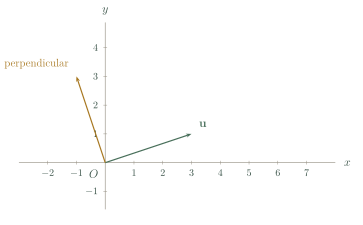
Use the angle's actual vertex
For an angle named , the middle letter is its vertex. Use and , with both arrows starting at B. Form the displacements before using the dot product so the calculation tests the intended angle.
Check that both displacements are non-zero. A coincident pair of points gives a zero displacement, which has zero dot product with every vector but no direction. A zero calculation alone cannot turn a degenerate angle into a right angle.
See the method in action.
Finding an unknown component
Find k if is perpendicular to .
Worked solution
- 1
Translate perpendicularity into an equation.
Both vectors are non-zero, so a zero dot product is equivalent to a right angle.
- 2
Expand and solve.
Matching component products give a linear equation for the unknown.
- 3
Verify the required condition.
The resulting non-zero vector is perpendicular to the given direction.
.
A right angle in a triangle
A=(1,1), B=(4,2), C=(3,5). Show that angle ABC is a right angle.
Worked solution
- 1
Form the two sides from the angle vertex B.
Angle ABC is formed by the two arrows starting at B.
- 2
Calculate their dot product.
The matching component products cancel.
- 3
Conclude that the angle is right.
Both side vectors are non-zero, so their zero dot product proves perpendicularity.
.
Try it yourself.
Check your understanding
Give a non-zero vector perpendicular to .
Show answer & reasoning
For example .
A quarter-turn of is . It is non-zero and , so it is perpendicular. Any non-zero scalar multiple of it also works.
Keep practising
6 worksheet questions · 14 marks
Read the questions online
- Are and perpendicular?2 marks
- Find if is perpendicular to .2 marks
- Find a unit vector perpendicular to .2 marks
- , , . Decide whether angle is a right angle.3 marks
- For , , find all real making perpendicular to .3 marks
- Explain why does not show a right angle.2 marks
Read the worked solutions
Equivalent correct methods earn the corresponding marks. Include units where asked.
- Are and perpendicular?2 marks
Their dot product is .
Yes. - Find if is perpendicular to .2 marks
.
. - Find a unit vector perpendicular to .2 marks
Rotate to and divide by its length five.
For example . - , , . Decide whether angle is a right angle.3 marks
; .
Their dot product is zero.
Yes. - For , , find all real making perpendicular to .3 marks
.
Set it equal to zero; the resulting vectors are both non-zero.
. - Explain why does not show a right angle.2 marks
The geometric perpendicularity conclusion requires both vectors to be non-zero.
The zero vector has no direction, so it forms no defined angle.
Curriculum reference & lesson scope
SACE Board of South Australia
Stage 1 Mathematics: vectors in the plane. Covers magnitude, components, geometry, scalar products, projections and proofs; follows the approved Specialist preparation structure.
Official curriculum source ↗