
Understand the idea.
Constant addition
An arithmetic sequence changes by the same amount each time. Calculate the common difference as later term minus earlier term. A negative difference makes the terms decrease; a zero difference gives a constant sequence.
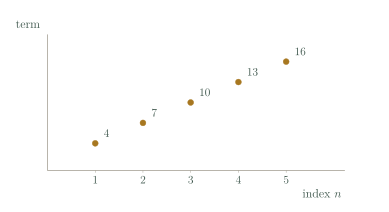
From to there are equal steps, giving . The discrete points lie on a straight line, but only permitted integer indices are sequence positions.
Unknown positions and two known terms
Two known terms determine the common difference: . The index gap counts the number of steps. Divide the change in value by that gap, then substitute into either term equation to recover .
If a question asks when a value is reached or crossed, solve the resulting equation or inequality for . Require a positive integer, and check the neighbouring indices when identifying the first term satisfying an inequality.
See the method in action.
Recovering a sequence
An arithmetic sequence has . Find its rule.
Worked solution
- 1
Write equations for the supplied terms.
Term four is three steps after the first; term ten is nine steps after it.
- 2
Subtract to isolate the difference.
There are six equal steps between indices four and ten.
- 3
Recover the first term.
Use the fourth-term equation with the known difference.
- 4
Form and simplify the rule.
The explicit rule starts at two and adds five per step.
.
Crossing a threshold
For , find the first negative term.
Worked solution
- 1
Write the decreasing term rule.
The common difference is negative three.
- 2
Require a negative value.
Dividing by a negative number reverses the inequality.
- 3
Choose and check the first allowed index.
The terms decrease, and the sign first changes between these consecutive indices.
.
Try it yourself.
Check your understanding
If , find .
Show answer & reasoning
.
Term six lies five steps after term one, so .
Keep practising
6 worksheet questions · 13 marks
Read the questions online
- Find for .2 marks
- Find when .2 marks
- An arithmetic sequence has . Find .2 marks
- Is 104 a term of ?2 marks
- Insert three arithmetic means between 6 and 26.2 marks
- Row 1 needs 9 tiles; each later row needs 4 more. Which row first needs more than 100?3 marks
Read the worked solutions
Equivalent correct methods earn the corresponding marks. Include units where asked.
- Find for .2 marks
; .
. - Find when .2 marks
.
. - An arithmetic sequence has . Find .2 marks
gives ; ; .
. - Is 104 a term of ?2 marks
; setting it to 104 gives .
No. - Insert three arithmetic means between 6 and 26.2 marks
Four equal intervals have size .
. - Row 1 needs 9 tiles; each later row needs 4 more. Which row first needs more than 100?3 marks
gives .
Row 24.
Curriculum reference & lesson scope
SACE Board of South Australia
Stage 1 Mathematics sequence and series content with introductory induction, regrouped into an original school-sized chapter.
Official curriculum source ↗