
Understand the idea.
A translation is a slide
A translation slides a shape without turning or flipping it. Choose one movement for the whole shape: every point must travel the same distance in the same direction. The resulting shape is called its image.
The first coordinate records horizontal position; the second records vertical position. Right and up increase the relevant coordinate, while left and down decrease it. A prime label, such as , matches an image point to its original.
Move each coordinate separately
Turn the movement into two coordinate changes before plotting. For four units right and two units up, add to every -coordinate and to every -coordinate. Apply both changes even if a point crosses an axis.
Calculate each vertex rather than guessing the outline. Then compare corresponding points: each should have the same horizontal and vertical change. A translation preserves lengths, angles and the direction in which the labelled vertices go around the shape.
See the method in action.
A point crossing both axes
Move 5 units right and 4 units down.
Worked solution
- 1
Record the coordinate changes.
Moving right increases the first coordinate; moving down decreases the second.
- 2
Calculate the new horizontal position.
Five steps right from negative two pass through zero.
- 3
Calculate the new height and label the image.
The image is one unit below the horizontal axis.
Translate all three vertices
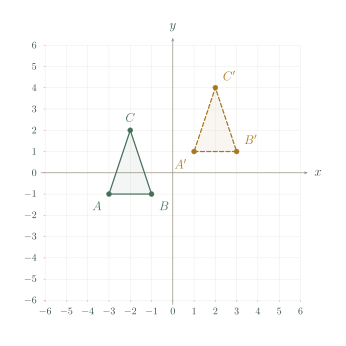
Translate , and 4 units right and 2 units up.
Worked solution
- 1
Use one rule for all three vertices.
Every point in a translation receives exactly the same movement.
- 2
Translate vertex A.
Add four horizontally and two vertically.
- 3
Translate vertex B.
The rule applies to B independently of A.
- 4
Translate vertex C.
All three coordinate pairs now record the required slide.
Try it yourself.
Check your understanding
moves 2 units left and 5 units up. Where is its image?
Show answer & reasoning
Two units left subtracts from the first coordinate; five up adds to the second. Thus .
Keep practising
6 worksheet questions · 13 marks
Read the questions online
- Translate 3 units left and 4 units up.2 marks
- Translate 5 units right and 1 unit down.2 marks
- is translated to . Describe the translation.2 marks
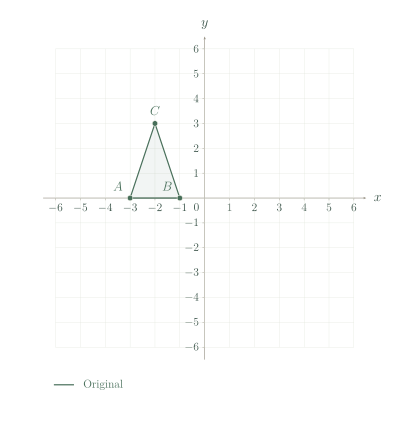
- Translate , and 2 units right and 2 units down. Give all image coordinates. Draw and label the image on the supplied grid.3 marks
- After moving 3 units right and 2 units up, a point is at . Find its original coordinates.2 marks
- A student maps to and to . Can this be one translation? Explain.2 marks
Read the worked solutions
Equivalent correct methods earn the corresponding marks. Include units where asked.
- Translate 3 units left and 4 units up.2 marks
; .
- Translate 5 units right and 1 unit down.2 marks
; .
- is translated to . Describe the translation.2 marks
The change in is .
The change in is .
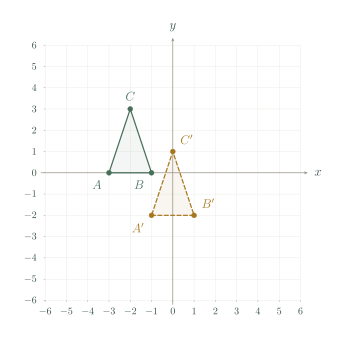
4 units right and 3 units down. - Translate , and 2 units right and 2 units down. Give all image coordinates. Draw and label the image on the supplied grid.3 marks
Add 2 to each x-coordinate and subtract 2 from each y-coordinate.
- After moving 3 units right and 2 units up, a point is at . Find its original coordinates.2 marks
Undo the movement: and .
- A student maps to and to . Can this be one translation? Explain.2 marks
Compare the changes for both vertices.
One translation must give the same change for every point.
No. A moves 2 right and 1 up, but B moves 3 right and 1 up.
Curriculum reference & lesson scope
Australian Curriculum v9 / South Australian Curriculum
Translations; reflections in coordinate axes; rotations about a point; recording transformations with coordinates; sequences of transformations; explaining what stays unchanged.
Official curriculum source ↗