
Understand the idea.
A rotation needs three instructions
A rotation turns a shape about a fixed centre. Describe the centre, angle and direction, clockwise or anticlockwise. For a half-turn, either direction gives the same image. The centre itself does not move.
Each point travels along part of a circle centred at the rotation centre. Its distance from the centre stays unchanged. Check both the turning direction and the distance; matching only one of them does not locate the image.
Use the grid as a turning guide
About the origin, a anticlockwise turn sends to ; a clockwise turn sends it to . A turn reverses both signs. A sketch helps you check which quadrant the image should occupy.
For a different centre, first subtract the centre coordinates to describe the point relative to it. Rotate that displacement, then add the centre coordinates back. The familiar origin rules turn displacements, so they cannot be applied directly to coordinates about another centre.
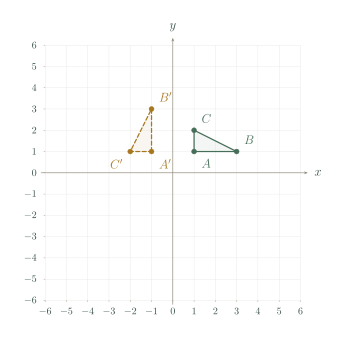
See the method in action.
Quarter-turn about the origin
Rotate through 90° anticlockwise about the origin.
Worked solution
- 1
Select the anticlockwise quarter-turn rule.
The stated centre is the origin, so the coordinate pair is already a displacement from it.
- 2
Substitute both coordinates.
Reversing negative two makes the new horizontal coordinate positive.
- 3
Check the direction and label the image.
Three right and two down turns to two right and three up.
Use the stated centre
Rotate through 90° anticlockwise about .
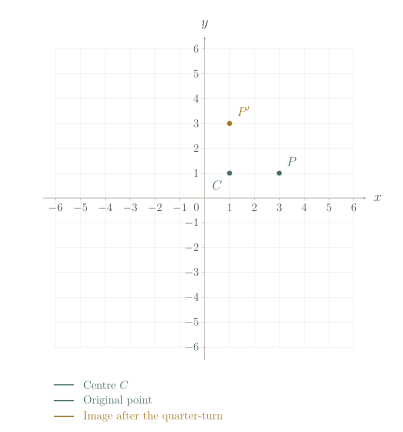
Worked solution
- 1
Measure P relative to the centre C.
The point starts two units right of C, rather than three units right of the origin.
- 2
Turn that displacement anticlockwise.
A quarter-turn changes a rightward movement into an upward movement.
- 3
Place the turned displacement back at C.
The image remains two units from the same rotation centre.
Try it yourself.
Check your understanding
Rotate through 180° about the origin.
Show answer & reasoning
A half-turn about the origin reverses both displacements: . The image stays the same distance from the origin.
Keep practising
6 worksheet questions · 13 marks
Read the questions online
- Rotate 90° clockwise about the origin.2 marks
- Rotate 90° anticlockwise about the origin.2 marks
- Rotate 180° about the origin.2 marks
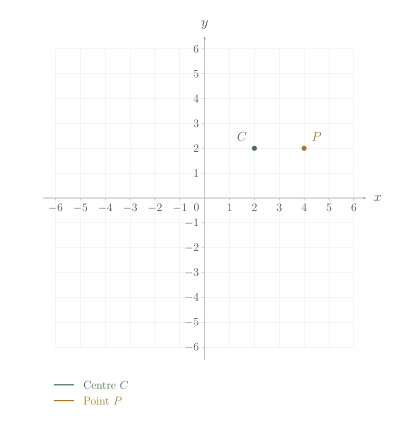
- Rotate 90° anticlockwise about .2 marks
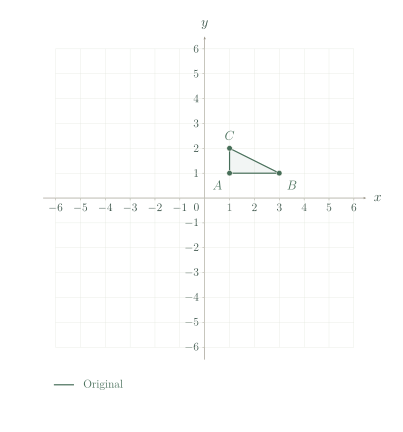
- Rotate , and 90° anticlockwise about the origin. Draw and label the image on the supplied grid.3 marks
- A point is the centre of a rotation. Where does that point go? Explain.2 marks
Read the worked solutions
Equivalent correct methods earn the corresponding marks. Include units where asked.
- Rotate 90° clockwise about the origin.2 marks
A 90° clockwise turn uses .
- Rotate 90° anticlockwise about the origin.2 marks
A 90° anticlockwise turn uses .
- Rotate 180° about the origin.2 marks
Change both signs for a half-turn.
- Rotate 90° anticlockwise about .2 marks
Relative to C, P is 2 units right.
After the turn, it is 2 units above C.
- Rotate , and 90° anticlockwise about the origin. Draw and label the image on the supplied grid.3 marks
Apply to each vertex.
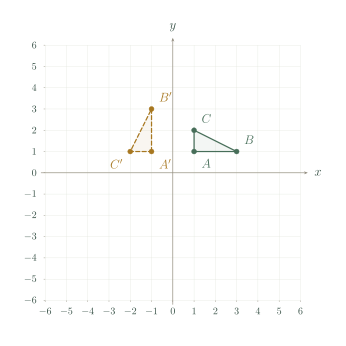
- A point is the centre of a rotation. Where does that point go? Explain.2 marks
Its distance from the centre is zero before and after every turn.
It stays at the same coordinates.
Curriculum reference & lesson scope
Australian Curriculum v9 / South Australian Curriculum
Translations; reflections in coordinate axes; rotations about a point; recording transformations with coordinates; sequences of transformations; explaining what stays unchanged.
Official curriculum source ↗