
Understand the idea.
The axis is a mirror line
A reflection uses a mirror line. Each point and its image lie the same perpendicular distance from that line, on opposite sides. The line joining them meets the mirror line at a right angle.
The coordinate axes make these distances easy to see. The -axis swaps above and below while keeping horizontal position. The -axis swaps left and right while keeping height. A point on the mirror line stays fixed.
Coordinate rules and checks
For an -axis reflection, keep and reverse the sign of . For a -axis reflection, reverse the sign of and keep . Think about which position crosses the mirror before using a rule.
Reflect every labelled vertex and join the matching image vertices. The shape retains its lengths, angles, perimeter and area, but the clockwise order of its vertices reverses. Zero stays zero, so points on the chosen axis do not move.
See the method in action.
Reflect a point in the x-axis
Reflect in the x-axis.
Worked solution
- 1
Identify the unchanged coordinate.
Reflection in the horizontal axis keeps the horizontal position.
- 2
Reverse the vertical displacement.
Two units below the mirror becomes two units above it.
- 3
Record the matching image point.
The original and image have equal perpendicular distances from the x-axis.
Reflect a triangle in the y-axis
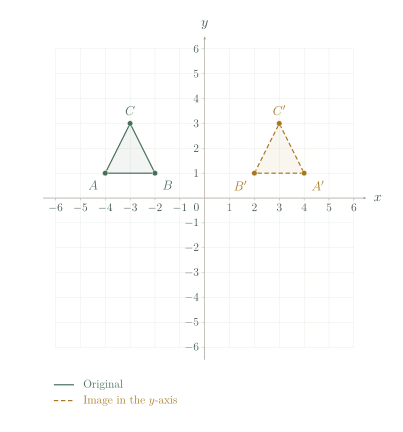
Reflect , and in the y-axis.
Worked solution
- 1
Write the y-axis rule.
The mirror swaps left and right without changing height.
- 2
Reflect A.
A lies four units left of the mirror, so its image lies four units right.
- 3
Reflect B.
B retains its height of one unit.
- 4
Reflect C.
C retains its height of three units.
Try it yourself.
Check your understanding
Reflect in the x-axis. Does it move?
Show answer & reasoning
; it stays fixed.
The point lies on the -axis. Reversing its zero vertical coordinate gives , so it stays at .
Keep practising
6 worksheet questions · 13 marks
Read the questions online
- Reflect in the x-axis.2 marks
- Reflect in the y-axis.2 marks
- Reflect in the y-axis. Explain why the result is unchanged.2 marks
- A point is reflected in the x-axis to . Find the original point.2 marks
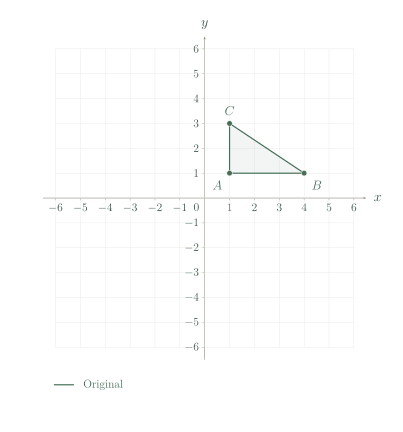
- Reflect , and in the y-axis. Give the image coordinates. Draw and label the image on the supplied grid.3 marks
- Jai says reflecting in the y-axis gives . Explain the mistake and give the correct image.2 marks
Read the worked solutions
Equivalent correct methods earn the corresponding marks. Include units where asked.
- Reflect in the x-axis.2 marks
Keep as 5; reverse the sign of .
- Reflect in the y-axis.2 marks
Reverse the sign of ; keep as 4.
- Reflect in the y-axis. Explain why the result is unchanged.2 marks
The point lies on the y-axis, so its perpendicular distance to the mirror line is zero.
- A point is reflected in the x-axis to . Find the original point.2 marks
Reflection undoes itself; reverse the sign of the image y-coordinate.
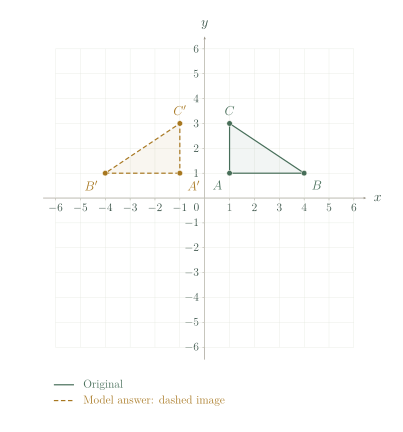
- Reflect , and in the y-axis. Give the image coordinates. Draw and label the image on the supplied grid.3 marks
Reverse each x-coordinate and keep each y-coordinate.
- Jai says reflecting in the y-axis gives . Explain the mistake and give the correct image.2 marks
Jai changed , which reflects in the x-axis.
For the y-axis, changes sign and stays the same.
Curriculum reference & lesson scope
Australian Curriculum v9 / South Australian Curriculum
Translations; reflections in coordinate axes; rotations about a point; recording transformations with coordinates; sequences of transformations; explaining what stays unchanged.
Official curriculum source ↗