
Understand the idea.
Invariant means unchanged
Translations, reflections and rotations are rigid transformations: they move a shape without stretching it. Corresponding side lengths and angles stay equal, so the original and image are congruent. Perimeter and area also stay unchanged.
Coordinates describe position, so they usually change even when size does not. Reflection reverses the clockwise or anticlockwise order of labelled vertices. Translation and rotation preserve that order. Reversing the order does not make the shape a different size.
Use measurements to test a claim
To find a measurement after a rigid transformation, calculate it from the original shape. A rectangle keeps both dimensions, and a triangle keeps its base and perpendicular height. Moving a figure to another grid position does not alter these measurements.
Equal angles alone do not establish a rigid movement: an enlargement also preserves angles but changes lengths. Check the properties relevant to the claim. A shape with doubled lengths has doubled perimeter and four times the area, so it is not congruent to its original.
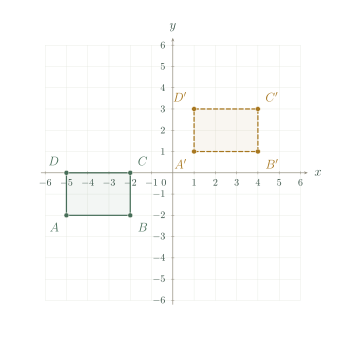
See the method in action.
A rectangle slides
A 3 cm by 2 cm rectangle is translated. Find the image perimeter and area.
Worked solution
- 1
Keep the original side lengths.
Translation preserves every length.
- 2
Add the four boundary lengths.
A rectangle has two copies of each side length.
- 3
Calculate the covered area.
The same rectangle dimensions give the same area after the slide.
Perimeter 10 cm; area .
A reflected right triangle
A right triangle has perpendicular sides 3 cm and 2 cm. It is reflected in a line. What happens to its right angle, area and vertex order?
Worked solution
- 1
Keep the right angle.
Reflection preserves the size of each angle.
- 2
Calculate the unchanged area.
The perpendicular sides form a base-height pair for the right triangle.
- 3
Describe the labelled vertex order.
Reflection flips the triangle, so clockwise order becomes anticlockwise and vice versa.
Right angle and area are unchanged; vertex order is reversed.
Try it yourself.
Check your understanding
A triangle of area is rotated. What is the image area?
Show answer & reasoning
Rotation is a rigid movement and preserves area. The image therefore still has area , regardless of its new position or direction.
Keep practising
6 worksheet questions · 14 marks
Read the questions online
- A 5 cm by 2 cm rectangle is reflected. Find its image perimeter and area.2 marks
- Which properties stay unchanged under a translation: coordinates, side lengths, angle sizes, area?2 marks
- A triangle is rotated 90°. Does its clockwise vertex order reverse? Explain.2 marks
- A rule maps a 2 cm side to a 4 cm side. Could it be a translation, reflection or rotation? Explain.2 marks
- A right triangle has perpendicular sides 4 units and 3 units. It is reflected in the y-axis. Find its area and state whether it is congruent to the original.3 marks
- A student claims two shapes must be congruent because they have equal area. Is this enough? Give a counterexample.3 marks
Read the worked solutions
Equivalent correct methods earn the corresponding marks. Include units where asked.
- A 5 cm by 2 cm rectangle is reflected. Find its image perimeter and area.2 marks
The side lengths stay 5 and 2.
and .
Perimeter 14 cm; area . - Which properties stay unchanged under a translation: coordinates, side lengths, angle sizes, area?2 marks
Coordinates generally change because the shape changes position.
Translation does not stretch the shape.
Side lengths, angle sizes and area. - A triangle is rotated 90°. Does its clockwise vertex order reverse? Explain.2 marks
All vertices turn together about the centre; there is no mirror reversal.
No. A rotation preserves clockwise/anticlockwise order. - A rule maps a 2 cm side to a 4 cm side. Could it be a translation, reflection or rotation? Explain.2 marks
The side has doubled, so the rule includes a size change.
No. Each of those transformations preserves side lengths. - A right triangle has perpendicular sides 4 units and 3 units. It is reflected in the y-axis. Find its area and state whether it is congruent to the original.3 marks
.
Reflection preserves all corresponding lengths and angles.
Area 6 square units; congruent. - A student claims two shapes must be congruent because they have equal area. Is this enough? Give a counterexample.3 marks
Equal area alone does not establish equal corresponding lengths and angles.
No. A 1 by 6 rectangle and a 2 by 3 rectangle both have area 6 but different side lengths.
Curriculum reference & lesson scope
Australian Curriculum v9 / South Australian Curriculum
Translations; reflections in coordinate axes; rotations about a point; recording transformations with coordinates; sequences of transformations; explaining what stays unchanged.
Official curriculum source ↗