
Understand the idea.
Two numbers identify one point
An ordered pair locates a point from the origin . Read the horizontal coordinate first: positive means right and negative means left. Then use the vertical coordinate: positive means up and negative means down.
Coordinates describe position, not an addition of the two numbers. Swapping them usually changes the location: is units right and up, while is right and up.
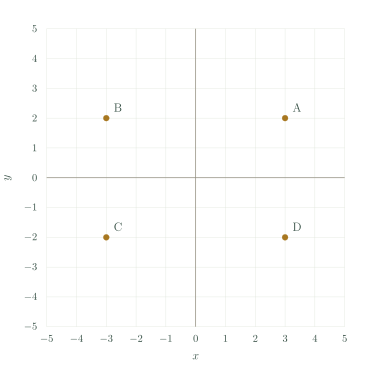
Quadrants and boundaries
The axes divide the plane into four quadrants. Starting in the top-right and moving anticlockwise, their sign pairs are I , II , III and IV . Use both signs to identify the region.
A zero coordinate places the point on a boundary: means the -axis, and means the -axis. Axis points belong to no quadrant. The origin is the point where both coordinates are zero.
See the method in action.
Left, then up
Which quadrant contains ?
Worked solution
- 1
Read the horizontal coordinate.
A negative horizontal coordinate places the point 3 units left of the origin.
- 2
Read the vertical coordinate.
A positive vertical coordinate places the point 2 units above the origin.
- 3
Identify the sign pair.
Left and above is quadrant II.
Quadrant II.
A point on a boundary
Describe the position of .
Worked solution
- 1
Check the horizontal coordinate.
With no left or right displacement, the point is on the y-axis.
- 2
Use the vertical coordinate.
The point is 4 units below the origin on the negative part of that axis.
- 3
Classify the position.
The axes are quadrant boundaries, so this point is not inside any quadrant.
On the y-axis, not inside a quadrant.
Try it yourself.
Check your understanding
Which quadrant contains ?
Show answer & reasoning
Quadrant IV.
The signs of are . The point is right of the origin and below it, which places it in quadrant IV.
Keep practising
6 worksheet questions · 12 marks
Read the questions online
- Describe the moves from the origin to .2 marks
- Name the quadrant containing .2 marks
- A point is 3 left and 4 up from the origin. Write its coordinates.2 marks
- Which axis contains ?2 marks
- Is the origin in quadrant I? Explain.2 marks
- Can a point with positive and negative lie in quadrant II? Explain.2 marks
Read the worked solutions
Equivalent correct methods earn the corresponding marks. Include units where asked.
- Describe the moves from the origin to .2 marks
Read before .
4 right, then 1 up. - Name the quadrant containing .2 marks
Both coordinates are negative: left and down.
Quadrant III. - A point is 3 left and 4 up from the origin. Write its coordinates.2 marks
Left gives ; up gives .
- Which axis contains ?2 marks
Its y-coordinate is zero.
The x-axis. - Is the origin in quadrant I? Explain.2 marks
At , neither coordinate is positive or negative.
No. It lies on both axes. - Can a point with positive and negative lie in quadrant II? Explain.2 marks
Quadrant II needs negative and positive .
No. Those signs place it in quadrant IV.
Curriculum reference & lesson scope
Australian Curriculum v9.0 / South Australian Curriculum
Year 7 coordinate, pattern and authentic-graph interpretation scope. Includes prerequisite four-quadrant plotting; formal gradient/intercept techniques are not required here.
Official curriculum source ↗