
Understand the idea.
Which inputs are allowed?
A discrete input takes separated values. Counts of whole people, tickets or apples can be , but cannot be . An arithmetic rule may calculate an output for even though the context forbids that input.
A continuous input can vary through intermediate values in a range. During steady filling, elapsed time could be , or minutes. Decide which inputs make sense before choosing how to draw the graph.
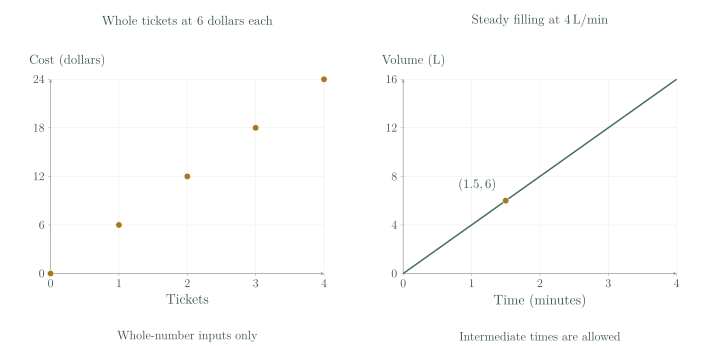
A connecting line makes a claim
A connecting line makes a statement about values between the plotted points. A straight segment represents constant change over that interval, so use it when both intermediate inputs and the assumed rate are supported by the model.
A few measurements alone do not establish steady behaviour between readings. If you join them as an approximation, say so. Category labels such as colours do not form a continuous numerical input scale merely because they appear along an axis.
See the method in action.
Whole tickets
Tickets cost 6 dollars each. Is (2.5,15) an allowed ticket-count/cost pair?
Worked solution
- 1
Check the arithmetic cost.
The pair agrees with the numerical rule of 6 dollars per ticket.
- 2
Check the allowed ticket counts.
Only whole tickets are sold, so the model has discrete inputs.
- 3
Decide whether the pair belongs.
The input lies between whole-number counts, so is excluded despite the correct multiplication.
No; use whole-ticket points.
Between readings
An empty tank fills steadily at 4 L/min. Is (1.5,6) part of the time/volume model?
Worked solution
- 1
Write the steady-filling model.
The tank starts empty and gains 4 litres for each elapsed minute.
- 2
Substitute the proposed time.
The model predicts 6 litres after 1.5 minutes.
- 3
Check that the input is possible.
Elapsed time can take this intermediate value, so the continuous filling model includes the pair.
Yes.
Try it yourself.
Check your understanding
A shop sells only whole apples. Is 3.7 apples an allowed input in its apple-count cost model?
Show answer & reasoning
No.
No: the shop sells whole apples, so its apple-count input is restricted to whole numbers. The value is excluded even if a cost rule can be evaluated there.
Keep practising
6 worksheet questions · 15 marks
Read the questions online
- Is the number of whole cars in a car park discrete or continuous? Explain.2 marks
- Rope is sold by measured length. Is length discrete or continuous in a mathematical model?2 marks
- Tickets cost 8 dollars each and only whole tickets are sold. Is allowed?2 marks
- An empty tank fills steadily at 2 L/min. Find the volume at 2.5 min and classify the model.3 marks
- The temperature is 20°C at noon and 24°C at 2 pm. Must it have been 22°C at 1 pm? Explain.3 marks
- Why should the tops of bars for red, blue and green not be joined to claim a continuous numerical relationship?3 marks
Read the worked solutions
Equivalent correct methods earn the corresponding marks. Include units where asked.
- Is the number of whole cars in a car park discrete or continuous? Explain.2 marks
Only whole-number car counts are possible.
Discrete. - Rope is sold by measured length. Is length discrete or continuous in a mathematical model?2 marks
Intermediate lengths such as 1.25 m are possible.
Continuous. - Tickets cost 8 dollars each and only whole tickets are sold. Is allowed?2 marks
, but 1.5 tickets cannot be bought in this model.
No. - An empty tank fills steadily at 2 L/min. Find the volume at 2.5 min and classify the model.3 marks
.
Times between whole minutes are allowed.
5 L; continuous. - The temperature is 20°C at noon and 24°C at 2 pm. Must it have been 22°C at 1 pm? Explain.3 marks
The actual temperature may change unevenly.
No. That is a straight-line model's prediction, not a fact established by two readings. - Why should the tops of bars for red, blue and green not be joined to claim a continuous numerical relationship?3 marks
A numerical halfway point between the colour categories has no meaning here.
The inputs are categories, not a numerical measurement scale.
Curriculum reference & lesson scope
Australian Curriculum v9.0 / South Australian Curriculum
Year 7 coordinate, pattern and authentic-graph interpretation scope. Includes prerequisite four-quadrant plotting; formal gradient/intercept techniques are not required here.
Official curriculum source ↗