
Understand the idea.
Differentiate the gradient
The second derivative measures how the tangent gradient changes. Where , gradients increase and the curve is concave up; where , gradients decrease and the curve is concave down.
Keep height and gradient separate. A decreasing curve can be concave up when its negative gradients move towards zero. Use to decide whether the function rises and to decide how it bends.
Use intervals, not a single point
Find possible concavity boundaries from zeros or undefined values of and from domain boundaries. Determine its sign on each resulting interval; an isolated zero alone does not describe the curve's bend on either side.
When is position in metres and time is in seconds, is velocity in and is acceleration in . Differentiating twice changes both the quantity and its units.
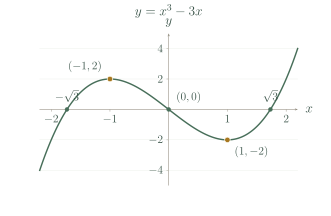
See the method in action.
Concavity of a cubic
Find the concavity of .
Worked solution
- 1
Differentiate twice.
Concavity depends on how the first derivative changes.
- 2
Find the candidate boundary.
The second derivative can change sign only at zero here because it is continuous.
- 3
Determine signs on both intervals.
Multiplication by positive 6 preserves the sign of x.
- 4
Translate the signs into concavity.
Negative second derivative means decreasing gradients; positive means increasing gradients.
Concave down on ; concave up on .
Acceleration as a second derivative
A position is metres, with t in seconds. Find acceleration at seconds.
Worked solution
- 1
Find velocity from position.
The first time derivative of position is velocity.
- 2
Differentiate velocity.
The second derivative of position is acceleration.
- 3
Evaluate at two seconds.
Acceleration has position units divided by time squared.
when position is in metres and time in seconds.
Try it yourself.
Check your understanding
Find the second derivative of .
Show answer & reasoning
First differentiate to obtain . Differentiating again gives ; the linear term contributes the constant .
Keep practising
6 worksheet questions · 15 marks
Read the questions online
- Find for .2 marks
- State the concavity of .2 marks
- For , find the intervals of concavity.3 marks
- Give an example of a function that decreases and is concave up for .3 marks
- A population model is . Find .2 marks
- If , does it follow that ? Explain.3 marks
Read the worked solutions
Equivalent correct methods earn the corresponding marks. Include units where asked.
- Find for .2 marks
Differentiate to obtain .
Differentiate once more.
- State the concavity of .2 marks
The first derivative is .
The second derivative is .
Concave down for all real . - For , find the intervals of concavity.3 marks
The second derivative is .
Solve and test signs.
Up for or ; down between these values. - Give an example of a function that decreases and is concave up for .3 marks
Its first derivative is .
Its second derivative is .
works. - A population model is . Find .2 marks
The first derivative is .
The second is .
people per time-unit squared - If , does it follow that ? Explain.3 marks
For the second derivative is positive.
Its first derivative is negative.
No. It says the gradient is increasing, not necessarily positive.
Curriculum reference & lesson scope
SACE Stage 2 Mathematical Methods
Further differentiation and applications from the current SACE Methods outline. Logarithmic derivatives have their own chapter; integration follows later. Trigonometric calculus uses radians.
Official curriculum source ↗