
Understand the idea.
Start with the basic graph
The graph has domain , range and vertical asymptote . Points , and give exact anchors for a sketch.
It increases while becoming less steep: and . As approaches zero from the positive side, the height tends to negative infinity; the graph has no point on the asymptote.
Read the input before drawing
For with nonzero , solve first. The boundary gives the vertical asymptote, and the sign of selects which side contains the graph.
The coefficient scales heights and reflects them if negative; translates vertically. Find intercepts by solving equations, and check whether is in the domain before trying to calculate a y-intercept.
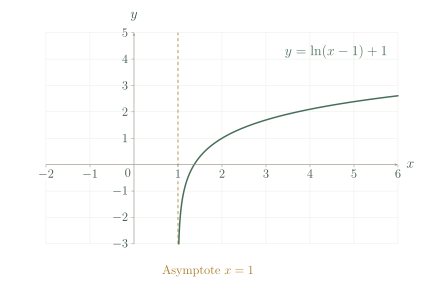
See the method in action.
Translate a graph
Give the domain, asymptote and intercepts of .
Worked solution
- 1
Find the domain and its logarithmic boundary.
As x approaches 1 from above, the positive input tends to zero and the height tends to negative infinity.
- 2
Set the height to zero.
An x-intercept is a point where y=0.
- 3
Exponentiate to find the x-intercept.
The exponential gives a positive input, so the resulting x-value satisfies x>1.
- 4
Check for a y-intercept.
A y-intercept requires the function to be defined at x=0.
Domain ; asymptote ; x-intercept ; no y-intercept.
Reflect and restrict
For , find the domain and the point where .
Worked solution
- 1
Solve the input restriction.
Rearranging the inequality puts the graph to the left of its boundary.
- 2
Set the requested height.
Subtracting 2 and changing both signs isolates the logarithm.
- 3
Reverse the logarithm and solve.
A logarithm is zero when its input is 1.
- 4
Check and give the point.
The candidate belongs to the domain and has the required height.
Domain and point .
Try it yourself.
Check your understanding
What is the vertical asymptote of ?
Show answer & reasoning
The input approaches zero at , from the allowed side . Multiplying the logarithm by and shifting it down by do not move that vertical asymptote.
Keep practising
6 worksheet questions · 15 marks
Read the questions online
- State the domain and asymptote of .2 marks
- Find the x-intercept of .2 marks
- Find the domain and y-intercept of .3 marks
- Describe the transformation from to .2 marks
- Find the inverse of and its domain.3 marks
- Sketch and on the same axes using exact anchor points. State their vertical separation.3 marks
Read the worked solutions
Equivalent correct methods earn the corresponding marks. Include units where asked.
- State the domain and asymptote of .2 marks
The input must be positive; its zero gives the asymptote.
; - Find the x-intercept of .2 marks
gives .
- Find the domain and y-intercept of .3 marks
gives ; substitute .
; - Describe the transformation from to .2 marks
The multiplier changes output values; the is applied afterwards.
Reflection in the x-axis, vertical scale factor 2, then translation up 3. - Find the inverse of and its domain.3 marks
gives . The original range is all real numbers.
, - Sketch and on the same axes using exact anchor points. State their vertical separation.3 marks
For , . Anchor points include and .
The second graph is units above the first; both have asymptote .
Curriculum reference & lesson scope
SACE Board of South Australia
Stage 2 Mathematical Methods: logarithmic functions and their applications; reciprocal-linear antiderivatives are taught in the Integration chapter.
Official curriculum source ↗