
Understand the idea.
Direction is carried by the sign of velocity
Velocity includes direction. Its signed integral is displacement, the difference between final and initial position. Speed is , so integrating speed gives total distance, counting movement in either direction positively.
Find zeros of velocity and check its sign on either side. A sign change indicates a reversal; touching zero without changing sign is only a stop. Initial position is needed for final position, but not for displacement or distance.
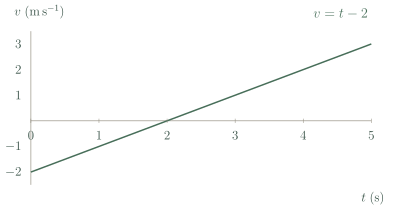
Work interval by interval
Split the time interval at every reversal. Add the signed interval integrals for displacement; add their magnitudes for distance. With movement in both directions, the distance exceeds the magnitude of displacement because opposite movements cancel only in displacement.
If acceleration is given, integrate once and use the initial velocity before analysing direction. Keep time units consistent: integrating metres per second with respect to seconds gives metres. A velocity-time sketch helps check the signs and relative contributions.
See the method in action.
Worked example
For m/s on , find displacement and distance.
Worked solution
- 1
Locate the reversal.
Velocity is negative before 2 seconds and positive afterwards.
- 2
Integrate each signed contribution.
Splitting at the reversal separates movement in the two directions.
- 3
Add signed changes for displacement.
Displacement allows movement in opposite directions to cancel.
- 4
Add magnitudes for distance.
Every metre travelled contributes positively to total distance.
Displacement m; distance m.
Worked example
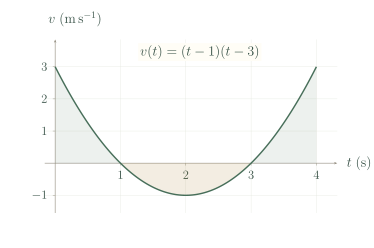
A particle has m/s on . Find distance.
Worked solution
- 1
Find the velocity zeros and signs.
The two linear factors change sign at 1 and 3, giving two reversals.
- 2
Find an antiderivative of velocity.
Expanding velocity gives , which can be integrated term by term.
- 3
Evaluate all three signed pieces.
The values , , and determine the interval changes.
- 4
Sum their magnitudes.
The negative middle displacement represents travel in reverse, which still contributes positive distance.
m
Try it yourself.
Check your understanding
on . Find displacement and distance.
Show answer & reasoning
m and m
Velocity changes sign at . The signed integrals are m on and m on , so displacement is m and distance is m.
Keep practising
6 worksheet questions · 18 marks
Read the questions online
- m/s on . Find displacement and distance.3 marks
- m/s on . Find displacement and distance.3 marks
- m/s on . Find displacement and distance.3 marks
- m/s on . Does it change direction at 2? Find distance.3 marks
- m/s and initial position is 5 m. Find position at 3 s.3 marks
- m/s for . Find distance.3 marks
Read the worked solutions
Equivalent correct methods earn the corresponding marks. Include units where asked.
- m/s on . Find displacement and distance.3 marks
Velocity is positive throughout; integrate 3 over 5 seconds.
Both 15 m. - m/s on . Find displacement and distance.3 marks
Velocity remains negative; integrate speed 2 for distance.
Displacement m; distance 8 m. - m/s on . Find displacement and distance.3 marks
Split at 1: contributions and 2.
Add signed values or magnitudes as needed.
m and m. - m/s on . Does it change direction at 2? Find distance.3 marks
Velocity is nonnegative on both sides of 2.
.
No; distance m. - m/s and initial position is 5 m. Find position at 3 s.3 marks
Displacement m.
Position m.
14 m - m/s for . Find distance.3 marks
Split at . Integrals are 1 and ; add their magnitudes.
m
Curriculum reference & lesson scope
SACE Board of South Australia
Stage 2 Mathematical Methods integration and logarithmic antiderivatives; original learning and assessment material, with by-hand methods and explicitly described numerical models.
Official curriculum source ↗