
Understand the idea.
A logarithm asks for an exponent
A logarithm gives an exponent: means . A valid real base has and . Since powers of a positive base are positive, the input must satisfy .
The output may still be negative. For a base greater than , a negative exponent produces a positive fraction below ; for example, , so .
Inverse functions swap input and output
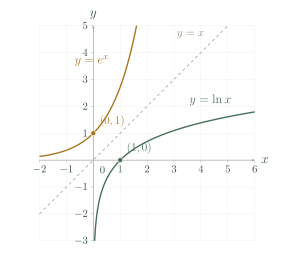
The inverse of reverses its input-output relationship. Exponential inputs can be any real number and outputs are positive; logarithmic inputs are positive and outputs can be any real number. The graphs reflect in .
To find an inverse, write , solve for the old input , then rename the variables. The inverse domain comes from the original range; inverse cancellation must retain any original input restrictions.
See the method in action.
Read a negative exponent
Evaluate .
Worked solution
- 1
Translate the logarithm into an exponent.
The logarithm asks which power of 4 produces one eighth.
- 2
Express both sides using base 2.
A common base makes the exponents comparable.
- 3
Equate exponents and solve.
The base-2 exponential is one-to-one, so equal outputs have equal exponents.
Find an inverse with a shifted input
Find the inverse of and state both domains.
Worked solution
- 1
Write the function and its domain and range.
A shifted exponent remains defined for all real inputs and has exactly the positive outputs.
- 2
Take a base-3 logarithm and solve for x.
The logarithm reverses exponentiation with the same base.
- 3
Rename the inverse variables and state its domain.
The inverse input is the original positive output; the original function domain is all real numbers.
, ; has domain .
Try it yourself.
Check your understanding
If , what is ?
Show answer & reasoning
Translate the statement into exponential form: . The negative logarithm value specifies a reciprocal power, not a negative input.
Keep practising
6 worksheet questions · 13 marks
Read the questions online
- Evaluate .2 marks
- Evaluate .2 marks
- Write as a logarithmic statement.2 marks
- Solve .2 marks
- Find the real domain of .2 marks
- Find the inverse of and its domain.3 marks
Read the worked solutions
Equivalent correct methods earn the corresponding marks. Include units where asked.
- Evaluate .2 marks
, so the required exponent is .
- Evaluate .2 marks
.
- Write as a logarithmic statement.2 marks
The logarithm records the exponent of base 7.
- Solve .2 marks
.
- Find the real domain of .2 marks
The input must satisfy .
- Find the inverse of and its domain.3 marks
. Solve for , then interchange names.
,
Curriculum reference & lesson scope
SACE Board of South Australia
Stage 2 Mathematical Methods: logarithmic functions and their applications; reciprocal-linear antiderivatives are taught in the Integration chapter.
Official curriculum source ↗