
Understand the idea.
The integral keeps the sign
A definite integral records signed area: values above the axis contribute positively and values below contribute negatively. Contributions may cancel even when the graph encloses substantial regions. A zero integral therefore does not mean zero geometric area.
Geometric area counts each piece positively. Find the zeros within the interval and determine the sign between them. Reverse the sign of any negative integral before adding the pieces; use square units when both coordinates measure lengths.
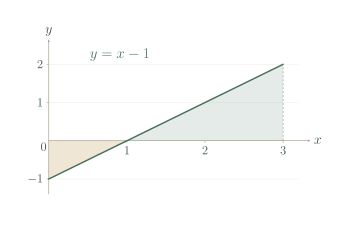
Use a sign chart before integrating
Build a sign chart from a factored expression, a test point in each interval, or the supplied graph. Splitting at every zero is safe, although a zero where the sign does not change does not require a reversal.
The notation describes geometric area, but hand calculation still needs the sign analysis. Taking the absolute value after adding all signed pieces loses regions that have already cancelled.
See the method in action.
Worked example
Find both and the area between the graph and axis.
Worked solution
- 1
Locate the sign change.
The line is negative from 0 to 1 and positive from 1 to 3.
- 2
Find the signed integral over the whole interval.
Upper minus lower keeps the cancellation between negative and positive contributions.
- 3
Calculate the two signed pieces.
Splitting at the zero separates the below-axis region from the above-axis region.
- 4
Add magnitudes for geometric area.
Geometric area counts both regions positively rather than cancelling them.
Signed integral ; area .
Worked example
Find the area between and the axis for .
Worked solution
- 1
Identify the sign on the interval.
The whole region lies on or below the axis, with zeros at the endpoints.
- 2
Reverse the integrand for area.
Axis height minus curve height is nonnegative throughout the interval.
- 3
Evaluate both endpoint values.
Subtracting the negative lower endpoint value adds the equal left-hand region.
Try it yourself.
Check your understanding
For on , what are the signed integral and geometric area?
Show answer & reasoning
and
The triangles on and each have area . Their signed contributions are opposite, giving integral 0, while their geometric areas add to 1.
Keep practising
6 worksheet questions · 18 marks
Read the questions online
- Find the area between and the axis on .3 marks
- Find and the corresponding geometric area.3 marks
- Find the area under on .3 marks
- Find the area between and the axis on .3 marks
- Find the area between and the axis on .3 marks
- A student says an integral of 0 proves that an area is 0. Give a counterexample.3 marks
Read the worked solutions
Equivalent correct methods earn the corresponding marks. Include units where asked.
- Find the area between and the axis on .3 marks
Split at 2.
Two triangles each have area 2.
- Find and the corresponding geometric area.3 marks
The signed contributions are and 2.
Their absolute values sum to 4.
and - Find the area under on .3 marks
The function is nonnegative, so integrate it directly.
- Find the area between and the axis on .3 marks
An antiderivative is .
Contributions on and are and .
Add their magnitudes.
- Find the area between and the axis on .3 marks
On the area is 2; on the signed integral is .
Add 2 and 2.
- A student says an integral of 0 proves that an area is 0. Give a counterexample.3 marks
The integral is 0 but the two triangular regions have total area 1.
on .
Curriculum reference & lesson scope
SACE Board of South Australia
Stage 2 Mathematical Methods integration and logarithmic antiderivatives; original learning and assessment material, with by-hand methods and explicitly described numerical models.
Official curriculum source ↗