
Understand the idea.
Probability is area
For a variable described by a probability density, probability is area under the curve over an interval. A height describes how densely probability is distributed near ; it is not the probability of that exact value.
A density is nonnegative everywhere and has total area . Its support identifies where it can be nonzero. An individual point has zero area, so including or excluding a single endpoint does not change an interval probability.
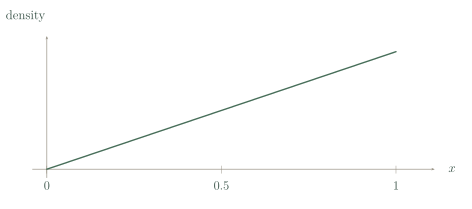
Normalise, then check
If a proposed density contains an unknown constant, set its integral over the support equal to and solve. Then check that the resulting function is nonnegative throughout that support. Both requirements are necessary for a valid density.
There is no upper bound of on a density's height. A tall curve can have area if its support is narrow enough. Probabilities are constrained to ; density heights are constrained only to be nonnegative.
See the method in action.
Find the scale factor
Find k if on [0,2] is a density.
Worked solution
- 1
Require total area one on the stated support.
The density is zero outside this interval, so all probability is included.
- 2
Integrate and solve for the constant.
The constant scales the entire area.
- 3
Check nonnegativity.
The normalised function satisfies the second density condition as well.
.
A tall density
Is on [0,0.5], zero elsewhere, a density?
Worked solution
- 1
Check that the height is nonnegative.
Outside the support the density is zero, which is also allowed.
- 2
Calculate the rectangle area.
The integral equals height times width for a constant density.
- 3
Conclude that the model is valid.
Both density conditions hold; a height above one does not invalidate an area-based probability model.
Yes.
Try it yourself.
Check your understanding
Find c if on [1,5] is a density.
Show answer & reasoning
.
The support has width , so its area is . Thus , which is nonnegative.
Keep practising
6 worksheet questions · 12 marks
Read the questions online
- Is on a density? Explain.2 marks
- Find if on is a density.2 marks
- Check both conditions for on .2 marks
- For any continuous density, find .2 marks
- A nonnegative triangular density has width 1 and height 2. Is its area correct?2 marks
- A function has integral one but is negative on part of its support. Is it a density?2 marks
Read the worked solutions
Equivalent correct methods earn the corresponding marks. Include units where asked.
- Is on a density? Explain.2 marks
Total area , not one.
No. - Find if on is a density.2 marks
.
. - Check both conditions for on .2 marks
and .
It is valid. - For any continuous density, find .2 marks
One point has zero width and zero area.
0. - A nonnegative triangular density has width 1 and height 2. Is its area correct?2 marks
.
Yes. - A function has integral one but is negative on part of its support. Is it a density?2 marks
Densities must be nonnegative on their support.
No.
Curriculum reference & lesson scope
SACE Board of South Australia
Stage 2 Mathematical Methods: continuous random variables, normal distributions and sampling distributions of sample means. Original lessons and practice.
Official curriculum source ↗