
Understand the idea.
Model before differentiating
Start an optimisation problem by defining the quantity to maximise or minimise. Use the constraint to express it in one variable, with units and a feasible domain, before finding a derivative.
A stationary input is a candidate, not a complete answer. Check that it is feasible and justify the absolute optimum using derivative signs, concavity or endpoint comparisons, including any allowed boundary cases.
Return to the situation
Return from the calculus variable to the original situation. Report all requested dimensions and the resulting area, volume or cost. An optimal value needs the appropriate units, not just the number found from .
Positive lengths usually make degenerate endpoints inadmissible. Keep that restriction visible and check behaviour near the boundaries. Technology can locate difficult candidates, but it cannot decide whether a model or its domain matches the situation.
See the method in action.
A rectangle with fixed perimeter
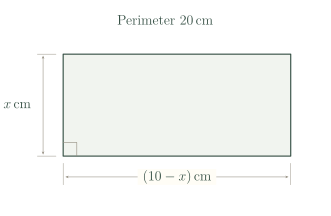
A rectangle has perimeter 20 cm. Find its largest possible area.
Worked solution
- 1
Use the perimeter constraint.
Both rectangle side lengths must be positive.
- 2
Express and differentiate the area.
The constraint reduces the area to a function of one variable.
- 3
Find the feasible stationary input.
Both dimensions satisfy the perimeter constraint and lie in the feasible range.
- 4
Justify the maximum and evaluate it.
The quadratic is concave down throughout the feasible interval, so its stationary point is the absolute maximum.
A cm square, with area .
A pen against a wall
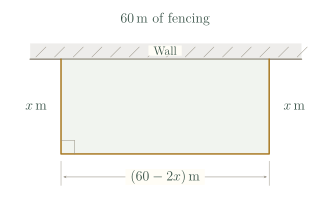
A pen against a wall needs fencing on three sides. With 60 m of fencing, find its maximum area.
Worked solution
- 1
Use only the three fenced sides.
The wall supplies the fourth side, while the two perpendicular sides each use x metres of fencing.
- 2
Form and differentiate the area.
The available fencing fixes the third side once x is chosen.
- 3
Find the dimensions at the stationary input.
The candidate gives positive side lengths within the feasible domain.
- 4
Verify and report the maximum area.
The area is concave down everywhere on the domain, so dimensions 15 m by 30 m give its absolute maximum.
, using dimensions m by m.
Try it yourself.
Check your understanding
A rectangle of area 36 cm squared has sides and . What expression gives its perimeter?
Show answer & reasoning
,
Area gives the second side for . Perimeter is twice the sum of the two sides: .
Keep practising
6 worksheet questions · 24 marks
Read the questions online
- A rectangle has perimeter 28 m. Find its maximum area.3 marks
- A three-sided pen beside a wall uses 80 m of fencing. Find optimal dimensions.3 marks
- Squares of side are cut from each corner of a 12 cm square to form an open box. Find the maximum volume.4 marks
- A product costs dollars to make units. Minimise average cost per unit.4 marks
- A point lies on a parabola. Find its least distance from .5 marks
- A closed cylinder has total surface area square centimetres. Find its largest volume.5 marks
Read the worked solutions
Equivalent correct methods earn the corresponding marks. Include units where asked.
- A rectangle has perimeter 28 m. Find its maximum area.3 marks
The sides are and .
Maximise , whose derivative vanishes at 7.
for a 7 m square. - A three-sided pen beside a wall uses 80 m of fencing. Find optimal dimensions.3 marks
Maximise .
The derivative is zero at 20.
20 m perpendicular to the wall and 40 m parallel; area . - Squares of side are cut from each corner of a 12 cm square to form an open box. Find the maximum volume.4 marks
The volume is , with .
Its derivative is .
The interior maximum is at 2; both limiting endpoint volumes are zero.
at cm. - A product costs dollars to make units. Minimise average cost per unit.4 marks
Average cost is .
Its derivative is , zero at 10.
The derivative changes from negative to positive.
per unit at . - A point lies on a parabola. Find its least distance from .5 marks
Minimise the square of distance: .
The stationary inputs are 0 and .
The smaller squared distance is ; take its square root.
, at . - A closed cylinder has total surface area square centimetres. Find its largest volume.5 marks
The constraint gives , where .
The volume is .
Its derivative vanishes at ; the endpoint volumes tend to zero.
at radius 2 cm and height 4 cm.
Curriculum reference & lesson scope
SACE Stage 2 Mathematical Methods
Further differentiation and applications from the current SACE Methods outline. Logarithmic derivatives have their own chapter; integration follows later. Trigonometric calculus uses radians.
Official curriculum source ↗