
Understand the idea.
Satisfy both conditions
A simultaneous solution is one pair satisfying both equations. On a graph, that pair is an intersection: its coordinates lie on both lines, rather than giving one point from each line.
Choose elimination when matching coefficients can cancel a variable. Choose substitution when one variable is already isolated. In either method, preserve equality at every step, then use the recovered variable to find the other.
Check a graph or calculator result
Graphing technology can suggest an intersection, but a poor window may hide it and displayed coordinates may be rounded. Substitute the proposed pair into both original equations to verify it.
Distinct parallel lines have no common point. Equivalent equations describe the same line and have infinitely many solutions. A contradiction or an identity in algebra explains these cases more reliably than a calculator message alone.
See the method in action.
Elimination
Solve and .
Worked solution
- 1
Add the two equations.
The coefficients of are opposites, so their terms cancel.
- 2
Find the first coordinate.
Divide both sides by 3 to isolate .
- 3
Recover the second coordinate.
The pair must also satisfy the original equation .
- 4
Verify both conditions.
Both equalities hold, so the simultaneous solution is .
.
An intersection
Find where meets .
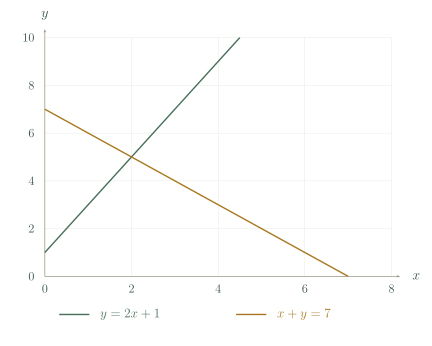
Worked solution
- 1
Equate the two expressions for height.
At an intersection the two lines have the same -value for the same .
- 2
Solve for the horizontal coordinate.
Adding and subtracting 1 preserves the equality.
- 3
Find and check the height.
Both original rules give , so the intersection is .
.
Try it yourself.
Check your understanding
Solve and .
Show answer & reasoning
.
Adding the equations gives , so . Then gives , and verifies the second equation.
Keep practising
6 worksheet questions · 12 marks
Read the questions online
- Solve and .2 marks
- Solve and .2 marks
- Find where meets .2 marks
- How many solutions do and have?2 marks
- How many solutions do and have?2 marks
- A solver returns for and . Verify it.2 marks
Read the worked solutions
Equivalent correct methods earn the corresponding marks. Include units where asked.
- Solve and .2 marks
Adding gives ; then .
. - Solve and .2 marks
Substitute : .
Thus , .
. - Find where meets .2 marks
gives ; then .
. - How many solutions do and have?2 marks
Doubling the first requires , which contradicts 15.
None. - How many solutions do and have?2 marks
The second equation is twice the first, so they describe the same line.
Infinitely many. - A solver returns for and . Verify it.2 marks
and .
Correct.
Curriculum reference & lesson scope
SACE Board of South Australia
Stage 2 General Mathematics: Modelling with Linear Relationships, a compulsory school-assessed topic. The external examination scope differs from the full course.
Official curriculum source ↗