
Understand the idea.
Feasible means every restriction holds
The feasible region contains only points satisfying every restriction together. Shade the common overlap of the allowed half-planes. Non-negativity and minimum quantities matter just as much as the resource bounds.
The overlap might be a bounded polygon, an unbounded region or empty. Test a point against every inequality before calling it feasible; satisfying one resource limit cannot compensate for breaking another.
Find the corners from active boundaries
Find possible vertices by intersecting boundary lines, including the coordinate axes. Then reject candidates violating any restriction. An axis intercept may be cut off by a tighter constraint before it becomes part of the feasible boundary.
Keep exact coordinates while solving and label them on the sketch. These verified vertices will later be used to compare objective values; inaccurate graph readings can change which decision appears best.
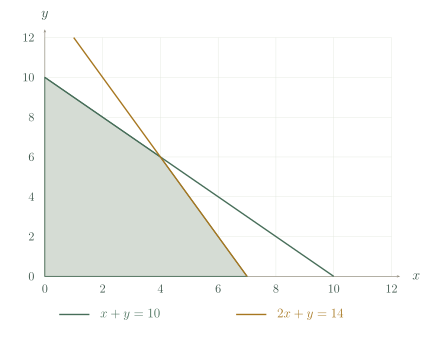
See the method in action.
Find the corners
Find the vertices for , and .
Worked solution
- 1
Find the feasible axis endpoints.
Both sloping constraints must hold, so the tighter bounds give and .
- 2
Intersect the sloping boundaries.
Subtracting the first equality from the second finds the shared corner.
- 3
Check the non-axis corner.
Both resources are exactly used and both coordinates are non-negative.
- 4
Collect the boundary corners.
The origin and axis endpoints also satisfy both upper bounds; these are the four corners of their common overlap.
.
An empty intersection
Can a point satisfy and together?
Worked solution
- 1
Combine the demands on the same sum.
Any feasible point would have to satisfy both inequalities simultaneously.
- 2
Identify the contradiction.
No real number can be at least 7 and at most 4.
- 3
State the feasible-set conclusion.
There are no feasible points. Choosing a different objective cannot repair inconsistent constraints.
No feasible points.
Try it yourself.
Check your understanding
Find vertices for , , .
Show answer & reasoning
.
The bounds are and . Combining their endpoint values gives the rectangle corners .
Keep practising
6 worksheet questions · 12 marks
Read the questions online
- Find vertices for and .2 marks
- Find vertices for , , .2 marks
- Find where meets .2 marks
- Is feasible for and ?2 marks
- Is the region , bounded?2 marks
- Why do and produce no feasible region?2 marks
Read the worked solutions
Equivalent correct methods earn the corresponding marks. Include units where asked.
- Find vertices for and .2 marks
The boundary meets both axes at 6.
. - Find vertices for , , .2 marks
At the sloping boundary gives ; check each corner.
. - Find where meets .2 marks
Subtract to obtain , then substitute.
. - Is feasible for and ?2 marks
The first sum is 8, but the second is 14.
No. - Is the region , bounded?2 marks
The feasible points exist for arbitrarily large .
No. - Why do and produce no feasible region?2 marks
A value cannot be at least 4 and at most 2.
No real meets both bounds.
Curriculum reference & lesson scope
SACE Board of South Australia
Stage 2 General Mathematics: Modelling with Linear Relationships, a compulsory school-assessed topic. The external examination scope differs from the full course.
Official curriculum source ↗