
Understand the method.
Make the pieces the same size. Add or subtract the numerators; keep the shared denominator.
Make the pieces the same size
The denominator names the size of each piece. The numerator counts the pieces. Before adding or subtracting, both fractions must count the same-sized pieces of the same whole.
Each quarter can be split into two eighths. The shaded amount stays the same: only the size and number of pieces change.
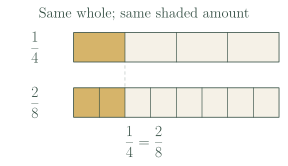
Rename, then add or subtract
When one denominator is a multiple of the other, use the larger denominator. Multiply the numerator and denominator by the same number to rename the fraction.
Now add or subtract the numerators. Keep the denominator because the pieces are still the same size.
Simplify and check the size
Simplify by dividing the numerator and denominator by the same common factor. Adding can make more than one whole; write an improper fraction as a mixed number when helpful.
Adding a positive amount makes the total larger. Taking away a positive amount makes it smaller. Use this check to spot an answer that cannot be right.
See the method in action.
Add thirds and sixths
Calculate .
Worked solution
- 1
Choose sixths as the shared unit.
Each third contains two sixths. Multiplying both numbers by keeps the fraction the same size.
- 2
Add the numerators and keep the denominator.
Four sixths plus one sixth makes five sixths. The pieces are still sixths.
- 3
Check the answer.
The sum is larger than the starting fraction and smaller than one whole. The answer is already in simplest form.
.
Read a subtraction model
The bar starts with of one whole. Remove of the whole. What fraction remains? Explain why two sixths are crossed out.
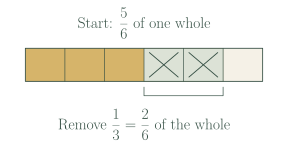
Worked solution
- 1
Read the size of the removed piece.
The complete bar has six equal parts. Two of those parts make one third of the whole.
- 2
Subtract the sixths that were removed.
There were five shaded sixths. Crossing out two leaves three shaded sixths.
- 3
Simplify the remaining fraction.
Divide both numbers by . Three of six equal parts cover half the whole, which is less than the starting amount.
of the whole remains.
Find the ribbon left over
A ribbon is long. Cut off . How much ribbon remains?
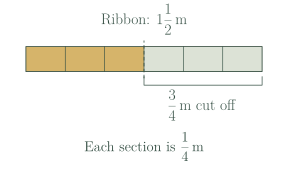
Worked solution
- 1
Rename the full length in quarters.
One whole contains four quarters and one half contains two more quarters.
- 2
Subtract the length that was cut off.
Both lengths now count quarters of a metre, so subtract their numerators.
- 3
State the unit and check the length.
The remaining length is smaller than the original ribbon. The fraction is already in simplest form.
of ribbon remains.
Try it yourself.
Calculate, explain, then apply.
Choose the shared unit
Calculate .
Show answer & reasoning
Rename , then add . If you got , you added the denominators. Keep tenths as the shared unit.
Interpret the pieces
A whole ribbon is divided into eighths. You have of the whole ribbon and remove of the whole. How many eighths remain?
Show answer & reasoning
Five eighths: of the whole ribbon.
, so . If you got , you treated three quarters as three eighths. A quarter contains two eighths.
Apply it to a recipe
A recipe uses of milk for one dish and for another. How much milk is needed altogether?
Show answer & reasoning
, so the total is . Five quarters is more than one whole. If you got , you left out the whole litre.
Keep practising
6 worksheet questions · 10 marks
Read the questions online
- Calculate .1 mark
- Calculate .1 mark
- Calculate .2 marks
- Calculate . Simplify your answer.2 marks
- For a picnic, Sam fills of a jug with juice and with water. What fraction of the jug is filled?2 marks
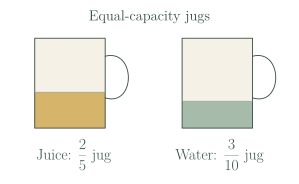
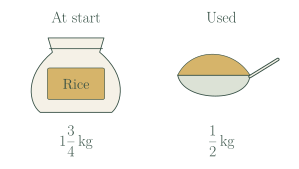
- A bag holds kilograms of rice. A cook uses kilogram. How much rice remains?2 marks
Read the worked solutions
Equivalent correct methods earn the corresponding marks. Include units where asked.
- Calculate .1 mark
Both fractions use sevenths. Add two and three.
- Calculate .1 mark
, so .
- Calculate .2 marks
. Subtract .
- Calculate . Simplify your answer.2 marks
. Then .
- For a picnic, Sam fills of a jug with juice and with water. What fraction of the jug is filled?2 marks
.
.
- A bag holds kilograms of rice. A cook uses kilogram. How much rice remains?2 marks
.
.
kilograms
Curriculum reference & lesson scope
Australian Curriculum v9.0; SA Curriculum Mathematics 2026
Equivalence; mixed numbers; ordering; related-denominator addition/subtraction.
Official curriculum source ↗