ASCENTLEARNING
Join a weekly class
Skip to learning content
YEAR 5 · COORDINATES AND TRANSFORMATIONS · 15 MIN

Translations/reflections/rotations

Translate, reflect and rotate a shape without changing its size or shape.

In this lesson

Before you start
  • Coordinates; grid movement; quarter turns
01 / LEARN

Understand the idea.

Slides and flips

A translation slides every point the same distance in the same direction. Move each vertex using the same instruction, then join the images in the original order. The shape keeps its size and orientation.

A reflection flips across a mirror line. Each point and its image are equally far from the line on opposite sides, measured at right angles. Points already on the mirror line stay fixed.
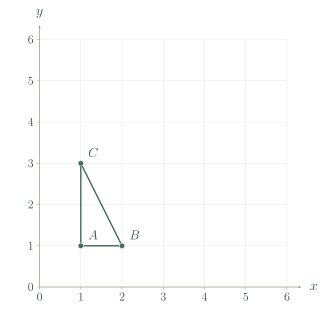
An equal-unit coordinate grid labelled from zero to six on both axes, with triangle vertices A at (1, 1), B at (2, 1) and C at (1, 3). The translated image is not drawn.

Turns need a centre

A rotation turns around a fixed centre. Specify the centre, turn size and direction, such as a quarter turn clockwise about (3,3). The centre stays fixed while the other points move around it.

Translations, reflections and rotations preserve lengths and angles. A reflection reverses orientation. Check every vertex: transforming just one corner gives too little information to draw the whole image correctly.

02 / WORKED EXAMPLES

See the method in action.

EXAMPLE 01

Translate all vertices

Translate A(1,1), B(2,1), C(1,3) by 2 right and 1 up.

An equal-unit coordinate grid labelled from zero to six on both axes, with triangle vertices A at (1, 1), B at (2, 1) and C at (1, 3). The translated image is not drawn.

Worked solution

  1. 1

    Move A two right and one up.

    x=1+2=3y=1+1=2A′=(3,2)

    The translation adds two horizontally and one vertically.

  2. 2

    Apply the same move to B.

    x=2+2=4y=1+1=2B′=(4,2)

    Every vertex must move by the same amounts.

  3. 3

    Apply the same move to C.

    x=1+2=3y=3+1=4C′=(3,4)

    The instruction changes position without changing the triangle dimensions.

  4. 4

    Join the three image vertices.

    Joining A-prime, B-prime and C-prime in the original order completes the translated triangle.

Answer

A′(3,2), B′(4,2), C′(3,4).

EXAMPLE 02

Reflect a point

Reflect P(1,2) across the vertical mirror line x = 3.
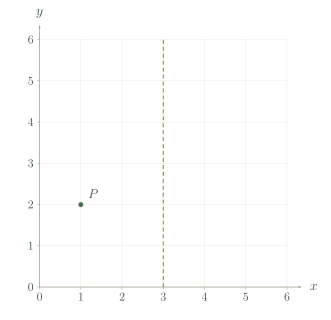
An equal-unit coordinate grid labelled from zero to six on both axes, with point P at (1, 2) and a gold dashed vertical mirror line at x equals 3. The reflected image is not drawn.

Worked solution

  1. 1

    Find the distance to the mirror.

    3−1=2 units

    P lies two horizontal units to the left of the vertical line x = 3.

  2. 2

    Locate the matching distance on the other side.

    3+2=5

    Reflection places the image equally far to the right of the mirror.

  3. 3

    Keep the height and write the image.

    P′=(5,2)

    A vertical mirror changes the horizontal position while preserving the vertical coordinate.

Answer

P′(5,2).

03 / YOUR TURN

Try it yourself.

Check your understanding

Translate (4,2) by 1 left and 2 up.

Show answer & reasoning

(3,4)

One left changes x to 4−1=3; two up changes y to 2+2=4. The translated point is (3,4).

Keep practising

6 worksheet questions · 10 marks

Read the questions online
  1. Translate P⁢(2,3) by 3 right and 1 down.
    1 mark
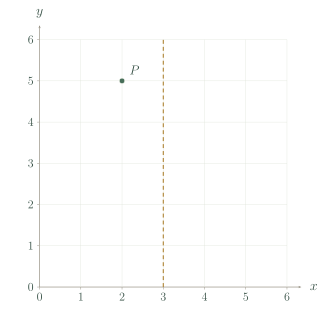
  2. Reflect P⁢(2,5) across x=3. Give its image coordinates.
    1 mark
    An equal-unit coordinate grid labelled from zero to six on both axes, with P at (2, 5) and a gold dashed vertical mirror line at x equals 3. The reflected image is not drawn.
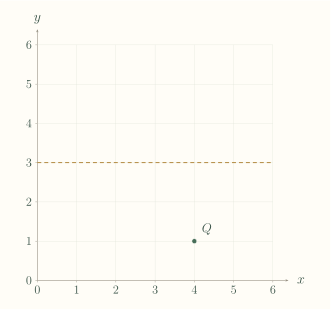
  3. Reflect Q⁢(4,1) across y=3. Give its image coordinates.
    1 mark
    Equal-unit coordinate grid from zero to six on both axes. Q is at (4, 1). A gold dashed horizontal line is at y equals 3. No reflected point is supplied.
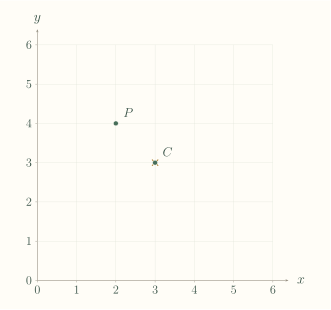
  4. Rotate P⁢(2,4) a quarter turn clockwise about C⁢(3,3). Find its image.
    2 marks
    Equal-unit coordinate grid from zero to six on both axes. P is at (2, 4). C is at (3, 3), with a gold cross marking the rotation centre. No rotated image is supplied.
  5. Translate A⁢(1,1), B⁢(2,1), C⁢(1,3) by 1 right and 2 up. Give all image coordinates.
    3 marks
    An equal-unit coordinate grid labelled from zero to six on both axes, with triangle vertices A at (1, 1), B at (2, 1) and C at (1, 3). The translated image is not drawn.
  6. A pupil moves two triangle corners 2 right but the third corner 3 right. Is this a translation of the whole triangle? Explain.
    2 marks
Read the worked solutions

Equivalent correct methods earn the corresponding marks. Include units where asked.

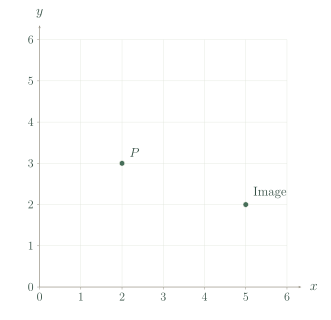
  1. Translate P⁢(2,3) by 3 right and 1 down.
    1 mark

    2+3=5; 3−1=2.

    (5,2)
    An equal-unit coordinate grid labelled from zero to six on both axes. P is at (2, 3) and Image is at (5, 2), showing a translation three units right and one unit down.
  2. Reflect P⁢(2,5) across x=3. Give its image coordinates.
    1 mark
    An equal-unit coordinate grid labelled from zero to six on both axes, with P at (2, 5) and a gold dashed vertical mirror line at x equals 3. The reflected image is not drawn.

    P is 1 left of the mirror, so its image is 1 right at the same height.
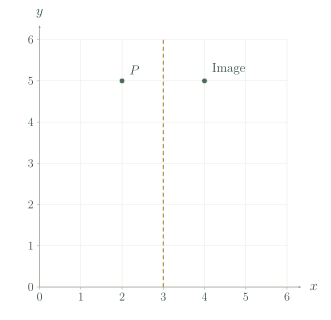
    (4,5)
    An equal-unit coordinate grid labelled from zero to six on both axes, with P at (2, 5), Image at (4, 5), and a gold dashed vertical mirror line at x equals 3. Both points are one unit from the mirror at the same height.
  3. Reflect Q⁢(4,1) across y=3. Give its image coordinates.
    1 mark
    Equal-unit coordinate grid from zero to six on both axes. Q is at (4, 1). A gold dashed horizontal line is at y equals 3. No reflected point is supplied.

    Q is 2 below the mirror, so its image is 2 above it.
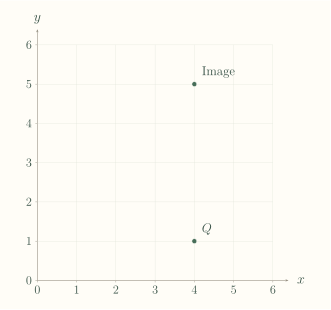
    (4,5)
    Equal-unit coordinate grid from zero to six on both axes. Q is at (4, 1), and its image is at (4, 5). The image is already supplied in this answer figure.
  4. Rotate P⁢(2,4) a quarter turn clockwise about C⁢(3,3). Find its image.
    2 marks
    Equal-unit coordinate grid from zero to six on both axes. P is at (2, 4). C is at (3, 3), with a gold cross marking the rotation centre. No rotated image is supplied.

    The offset from C is 1 left and 1 up. A clockwise quarter turn changes this to 1 right and 1 up.
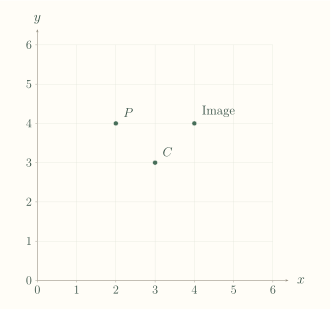
    (4,4)
    Equal-unit coordinate grid from zero to six on both axes. The rotation centre C is at (3, 3), P is at (2, 4), and the supplied image is at (4, 4).
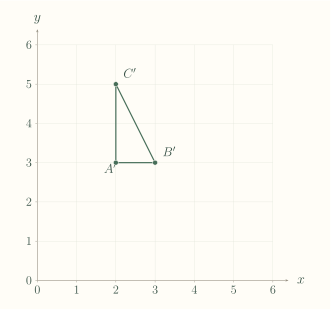
  5. Translate A⁢(1,1), B⁢(2,1), C⁢(1,3) by 1 right and 2 up. Give all image coordinates.
    3 marks
    An equal-unit coordinate grid labelled from zero to six on both axes, with triangle vertices A at (1, 1), B at (2, 1) and C at (1, 3). The translated image is not drawn.

    Move all three points by the same amounts.

    A′(2,3), B′(3,3), C′(2,5).
    Equal-unit coordinate grid from zero to six on both axes. The triangle joins A prime at (2, 3), B prime at (3, 3), and C prime at (2, 5). Only the supplied translated image is shown.
  6. A pupil moves two triangle corners 2 right but the third corner 3 right. Is this a translation of the whole triangle? Explain.
    2 marks

    Moving one corner differently can change side lengths or the shape.

    No. Every point must move by the same distance in the same direction.
Checking saved progress…
Curriculum reference & lesson scope

Australian Curriculum v9 / SA Curriculum Mathematics 2026

Constructing grids; ordered coordinates; movement; translations/reflections/rotations; symmetry.

Official curriculum source ↗

Save your next step.

Create a free account to save your learning progress. Lessons and downloads stay free, with or without an account.

Create free account